Artificial Intelligence is no longer just a technology topic in India. For many students and working professionals, it has become a career survival skill.
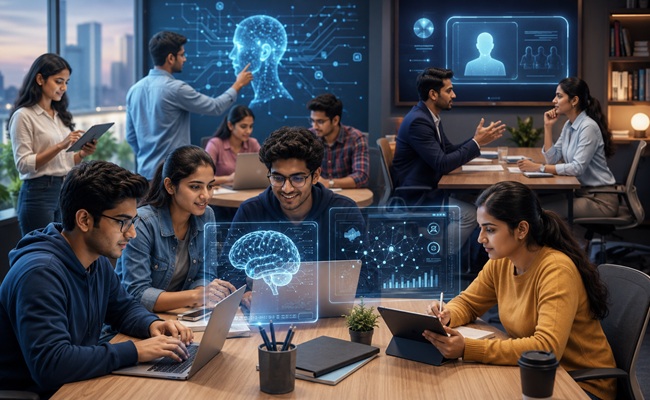
From college campuses to offices, Indians are rushing to learn AI. Students are using AI-powered mock interviews before placements.
Mid-career professionals are joining Generative AI bootcamps after office hours. Commerce graduates are learning prompt engineering. HR aspirants are using AI tools to improve hiring skills.
Even school students are now being introduced to AI and computational thinking.
India is clearly in the middle of a big AI learning rush.
The numbers show how huge this trend has become. India now has 34.2 million learners on Coursera, making it the platform’s second-largest market globally. The country has also recorded 21 percent year-on-year growth in learners.
Generative AI courses are seeing even faster growth. Indian learners are enrolling in GenAI courses at the rate of three enrollments every minute, compared to one every four minutes in 2023.
Across campuses and workplaces, AI is no longer being seen as an optional skill. It is slowly becoming a basic requirement for employability.
Experts say students are now moving from curiosity-based learning to career-focused learning. AI is being treated like Excel or coding once was a skill that can improve job chances.
The trend is not limited to engineering students. Students from management, commerce, tier-2 and tier-3 colleges are also joining AI courses because they see it as a core career skill.
Several edtech platforms are also seeing strong interest from non-technical learners.
Many students and professionals are not trying to become AI scientists. They simply want to use AI tools to become more productive and job-ready.
For many young Indians, AI has become a form of career insurance. There is a growing fear that the future job market will reward those who know how to work with AI and punish those who do not.
Students are also using AI tools to overcome placement fears. Many are practising mock interviews and assessments through AI-based platforms to improve confidence.
This shows a major shift in India’s skilling system. Students are no longer satisfied with only watching videos or collecting certificates. They now want simulations, hackathons, real projects and practical assessments that help them prepare for actual jobs.
At the same time, experts warn that simply joining an AI course is not enough.
The job market is not rewarding people who merely know what AI is. It is rewarding those who can use AI to solve real problems. This has created a major readiness gap. Many students have certificates, but they may not be ready to perform from day one at work.
Recruiters are now giving more importance to applied learning, portfolios and real skills rather than certificates alone.
The AI craze has also created a huge education business in India. Students can now choose from free YouTube tutorials, online certifications, bootcamps, IIT-backed executive programs and full-time AI degree courses.
Introductory online courses may cost anywhere from free to Rs 5,000. Certification programs can cost between Rs 10,000 and Rs 60,000.
Advanced bootcamps may go from Rs 75,000 to more than Rs 3 lakh. IIT-backed executive AI certifications can cost nearly Rs 2 lakh or more.
But this boom has also created a trust problem. Many low-quality courses are flooding the market with big promises. Some simply repackage free content and sell it with fancy claims like “become an AI expert in two weeks.”
Experts say students must be careful while selecting AI courses. They should check whether the course has live teaching, real projects, updated curriculum, mentorship, doubt-solving and career support.
The AI wave is also entering schools. CBSE has already introduced AI and computational thinking for students from Classes 3 to 8. This shows that AI is slowly becoming a basic digital skill, like coding or internet literacy.
Another important trend is the rising participation of women in AI learning. Women now account for 33.5 percent of GenAI enrollments in India, up from 31.2 percent a year earlier. Women are also completing GenAI courses at slightly higher rates than men.
Flexible online learning and non-coding AI tools appear to be helping more women enter technology-linked career paths.
Overall, India’s AI learning boom is more than just an education trend. It reflects a bigger change in how students and professionals think about jobs, skills and future security.
A decade ago, coding became the gateway to opportunity for many Indians. Today, AI literacy is beginning to occupy a similar space.
But the real question remains: are AI courses helping students get jobs?
The answer is mixed. Good AI courses with projects, mentorship and industry application can definitely improve employability. But random certificates without practical skills may not help much.
In simple terms, AI learning can open doors only if students know how to use it in real work. The certificate alone will not get the job. Practical ability will.