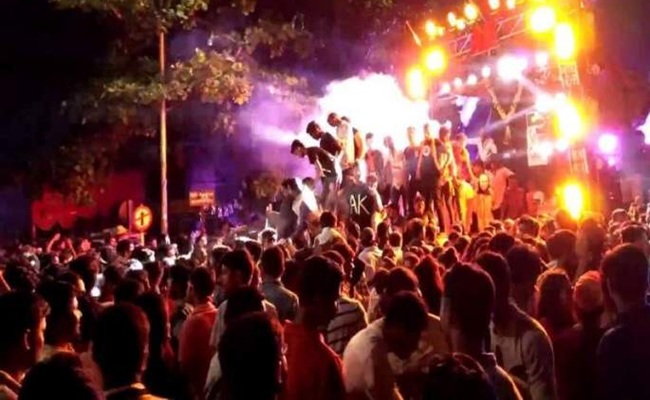
Vinayaka Chavithi is a festival of devotion. It should not become a licence for public nuisance. Yet every year, massive DJ systems turn processions into deafening spectacles.
Question the noise, and the immediate response is often predictable: “Are you anti-Hindu?” That is not an argument. It is an attempt to shut down a legitimate public concern.
The uncomfortable truth is that even Hindu religious leaders and Sanatana Dharma preachers have largely failed to confront this problem.
Devotion does not require speakers powerful enough to shake buildings. Ganapati does not need deafening bass to prove anyone’s faith. A festival can be vibrant without becoming a nightmare for everyone living along the procession route.
Increasingly, sections of youth appear to be turning religious processions into entertainment events, where louder DJs and bigger processions are treated as symbols of prestige.
This competition for noise has little to do with spirituality. It is simply nuisance dressed up as devotion.
The consequences can be serious.
On September 22, reports emerged from Balrampur in Uttar Pradesh about seven-year-old Class 2 student Vaishnavi Tiwari collapsing in her classroom while a Ganesh immersion procession with loud DJ music was passing nearby.
Her family reportedly linked her death to the excessive noise, while police were said to be investigating the circumstances of the incident.
Such incidents should at least force a serious conversation.
Elderly people, infants, pregnant women and those with certain medical conditions can be particularly vulnerable to intense noise and prolonged disturbance. Nobody should have to surrender basic peace simply because a procession is passing outside their home.
India already has noise-control rules. Loudspeakers require permission, sound levels are subject to prescribed limits, and night-time use is restricted, with only limited exemptions under specific conditions.
The real problem is enforcement.
Courts have also repeatedly raised concerns over excessive noise during festivals and stressed that ordinary citizens should not be made to suffer because rules are ignored.
Political leaders, too, cannot escape scrutiny.
Andhra Pradesh minister Nara Lokesh recently urged officials to simplify permissions for DJ vehicles during Ganesh immersion and reportedly said that DJ vehicles should not be seized unnecessarily, while also asking authorities not to create avoidable hurdles for organisers.
Such positions raise a larger question: are political leaders reluctant to enforce stricter noise rules because they fear being branded “anti-Hindu”?
This is not about one politician or one state. Across India, political parties often hesitate to take firm action when religious sentiment is involved.
India already struggles with pollution, poor sanitation and chaotic public spaces. Sound pollution should not become another festival-season free-for-all.
Ganesh Chaturthi, Diwali and other celebrations are all part of India’s plural society. The answer is not to attack religion. It is to separate faith from noise, celebration from nuisance, and devotion from disorder.
A confident religious tradition should be able to celebrate without demanding that everyone else silently endure the disturbance.