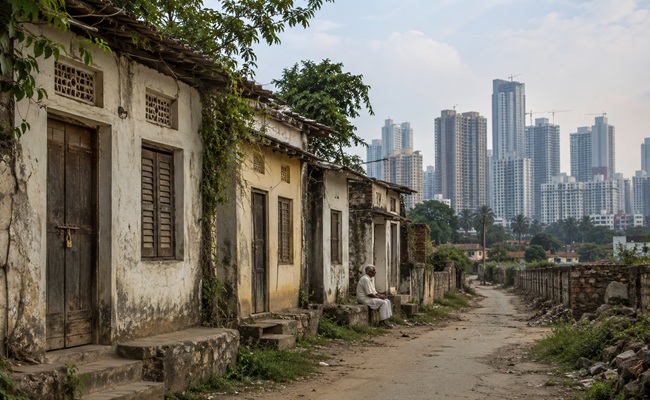
Japan is facing a strange but serious housing crisis. Nearly 9 million homes are lying vacant across the country.
These empty houses, known as akiya, are not just unfinished buildings or newly abandoned properties. Many were once family homes, but are now left locked, silent and slowly decaying.
According to Japan’s 2023 housing survey, nearly 13.8% of all homes in the country are now vacant, the highest level ever recorded.
The reasons are clear: ageing population, falling birth rate, rural depopulation, inheritance complications, high repair costs and young people moving to big cities for jobs.
This may look like Japan’s problem today, but India should not ignore the warning.
India is still a young country compared to Japan, but one trend is already visible: people are moving rapidly from villages and small towns to cities.
Hyderabad, Bengaluru, Mumbai, Pune, Chennai, Delhi-NCR and other urban centres are attracting students, workers, software employees, small business owners and service professionals.
The United Nations has projected that India will add 416 million urban dwellers by 2050, the highest increase for any country. This means millions of people will continue leaving rural areas and smaller towns in search of education, jobs, healthcare and better lifestyles.
When such migration happens on a large scale, the first impact is seen in housing.
In cities, rents and land prices go up. Apartments become smaller and more expensive. Families struggle to buy homes near workplaces.
At the same time, houses in villages and old towns slowly become empty. Parents grow old, children settle in cities or abroad, and ancestral homes remain locked for most of the year.
This is already happening in many parts of India. In several villages, old houses are opened only during festivals, marriages or family functions. In some places, only elderly people remain, while the younger generation has moved permanently to cities.
After the older generation passes away, the next generation often does not want to return. They may not have jobs in the village. They may not want to spend money repairing an old house. Inheritance disputes among siblings may delay sale or maintenance. Some properties remain locked because nobody wants to take responsibility.
This is exactly how Japan’s ghost home problem became serious.
India may not face the same crisis immediately because its population is still growing. But in many rural regions and old town areas, a slow version of this crisis is surely possible.
The danger is not that India will suddenly have millions of empty homes tomorrow. The danger is that empty homes, unused land and dying villages may gradually become normal.
There is another angle. Many Indians still build large houses in their native places for prestige, even when their children have no plan to live there.
Families spend huge amounts on big houses in villages or small towns, but after a few years, those houses remain locked. Maintenance becomes difficult. Security becomes a problem. Over time, the property starts losing practical value.
Urban migration will also change family structures. Earlier, one ancestral house served many generations. Now, each generation is building its own life in a different city.
A son may live in Hyderabad, a daughter in Bengaluru, another family member in the US, and parents in the native place. After one generation, the emotional connection with the old house weakens.
If India does not plan properly, many villages may face a double crisis: empty houses on one side and lack of economic activity on the other.
The solution is not to stop people from moving to cities. Migration is natural when people look for better opportunities. But governments must make smaller towns and rural regions economically useful. Better schools, hospitals, internet connectivity, local industries, tourism, remote-work hubs and small business ecosystems can reduce forced migration.
Old houses can also be converted into homestays, rental homes, rural workspaces, community centres or senior care homes. Clear property records and faster inheritance settlements are also necessary. Otherwise, many homes will remain stuck in legal and emotional confusion.
Japan’s ghost homes are a warning to India. A country cannot focus only on building new cities while allowing old settlements to slowly die.
Today, India is worried about urban crowding, high rents and traffic jams. Tomorrow, it may also have to worry about locked houses, abandoned streets and villages without young people.
The future may not look exactly like Japan, but the direction is visible. If most of the population keeps moving towards big cities, India too may one day face its own version of the ghost homes crisis.