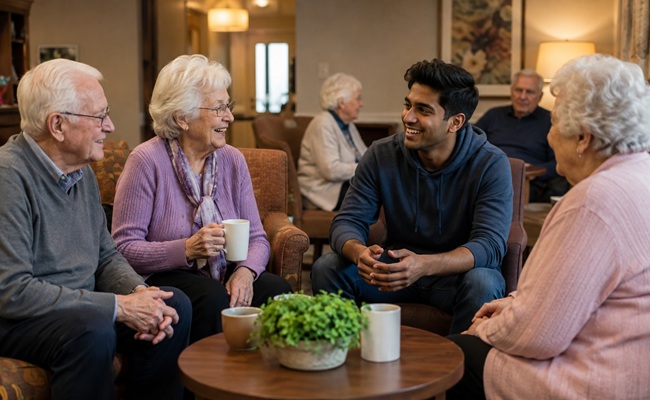
For 23-year-old Indian student Shojin Samson, moving to the United States did not mean living in a hostel or sharing an apartment with students his own age.
Instead, he chose to live in a retirement community surrounded by more than 600 senior citizens. The unusual arrangement helped him reduce his rent while also giving him the family connection he had missed for years.
While most university students prefer noisy apartments, late-night parties and roommates of a similar age, a growing number of students in the US are choosing a very different lifestyle.
They are moving into retirement communities, where they receive affordable housing in return for spending a few hours every week volunteering and interacting with elderly residents.
For students, the arrangement offers lower rent, safety and a strong sense of community. For senior citizens, it provides regular companionship, youthful energy and meaningful social interaction.
Such intergenerational housing programmes are slowly gaining popularity in the US as organisations try to address two major problems: rising housing costs and loneliness.
One of the students taking part in such a programme is 25-year-old Daija Holliday, who moved from North Carolina to study counselling psychology at Marquette University in Milwaukee.
Instead of renting a regular apartment, she chose to live at St Camillus Life Plan Community, a retirement facility with more than 600 older residents.
Holliday pays about $500 per month for an independent apartment, which is reportedly around one-third of the local market rent for a one-bedroom home.
In return, she volunteers for eight hours every week.
Her activities include serving coffee and newspapers, helping residents with errands, conducting Saturday morning fitness sessions and organising game nights.
Holliday said she grew up in her grandparents’ home, so living with older people felt natural.
“It is my family away from home. I always feel like they have my back,” she said.
However, she admitted that the quiet lifestyle may not suit every student.
“By 7.30 or 8 pm, things get pretty quiet here. If you are looking for more activity at night, this is not for you,” she said.
Experts say intergenerational living is becoming more common in the US.
Some students stay in retirement communities, while others take part in home-sharing programmes in which young adults and senior citizens live together.
Sheri Steinig of the nonprofit organisation Generations United said the idea helps address housing affordability and social isolation at the same time.
She explained that people living in the same space are more likely to have natural and spontaneous conversations rather than meeting only during organised events.
Similar programmes have been introduced in other places. St Olaf College in Minnesota recently launched an initiative allowing students to live in retirement-community townhouses while interacting with senior residents.
The Marquette programme began in 2022 and was inspired by a model launched in the Netherlands in 2012.
Under the Dutch programme, university students live rent-free in apartments inside a retirement community in exchange for spending at least 30 hours a month with elderly residents.
Loneliness affects both older and younger people.
Senior citizens may become isolated because of health problems, reduced mobility, limited transport or the loss of family members. Young adults may also struggle with loneliness after leaving home for education or employment.
Intergenerational housing programmes help both groups build relationships while reducing age-related stereotypes.
Jennifer Molinsky of the Harvard Joint Center for Housing Studies said such arrangements create valuable connections between generations and allow people to learn from one another.
The Marquette programme is led by Stacy Barnes, director of the Wisconsin Geriatric Education Center.
She said the programme is open to students from different academic backgrounds, but applicants must genuinely enjoy spending time with older people.
“We are interested in students who are looking for more than cheap rent,” Barnes said.
Students living at St Camillus also have access to facilities including a gym, swimming pool, cinema, restaurants, lounges and a pub.
They are also given monthly dining credits so that they can share meals with residents and build closer relationships.
Among the students living at St Camillus is Shojin Samson, who moved from India to study at Marquette University.
It was his first time living abroad and his first experience of American culture.
Samson said the retirement community felt familiar because it reminded him of the mixed-age neighbourhoods he had known in India.
His experience became deeply emotional because he had lost his grandparents when he was around six years old.
“I have always had this void. There was a space I wanted to fill in my life. I am delighted and blessed to say that I now have so many grandparents,” he said.
Jeremy Pust, executive director of independent living at St Camillus, said the presence of younger residents had also positively affected the seniors.
He said young students bring energy, comfort and companionship, particularly to residents whose families live far away.
For Samson, the arrangement provided much more than affordable housing. Thousands of kilometres away from India, he found a new family in an unexpected place.