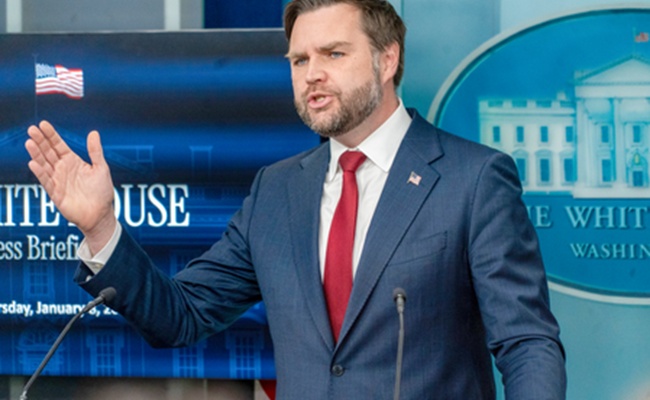
US Vice President JD Vance has defended the administration’s $100,000 payment requirement for certain H-1B petitions, saying the visa programme should be used to bring highly skilled talent into the country rather than allow companies to replace American workers with lower-paid foreign employees.
Speaking on the All-In Podcast, Vance said the H-1B programme “should not exist to replace American workers with low-wage foreigners” and argued that it should instead contribute to the growth of the US economy.
Vance said the programme was intended to attract exceptional talent and strengthen sectors such as technology, not simply give employers a cheaper alternative to similarly qualified American workers.
To explain his point, he referred to a hypothetical case in which a company replaces an American employee earning $60,000 with a foreign worker earning $45,000. He said the H-1B system should not be used as a tool to cut labour costs at the expense of US workers.
Vance also questioned companies that seek H-1B workers while simultaneously laying off large numbers of American employees. He said the administration is looking at ways to prevent companies from using the programme in such situations.
His comments come as the Trump administration continues to tighten scrutiny of the H-1B programme. A September 18 proclamation extended restrictions on the entry of certain H-1B workers through September 21, 2027.
Under the measure, covered petitions for workers outside the United States generally require a $100,000 payment, subject to specified exceptions.
Vance said the administration turned to executive action because, in his view, Congress lacked the political will to pass broader reforms addressing alleged loopholes and fraud in the system.
The $100,000 requirement has added to uncertainty around the H-1B programme, particularly for employers and prospective applicants. Indian professionals, who make up a large share of H-1B beneficiaries, are closely watching further policy changes.
Vance’s remarks also suggest that the administration may pursue additional restrictions or enforcement measures, particularly involving companies that lay off US workers while continuing to seek foreign employees through the H-1B programme.