There was a time when fans worried about whether their favourite team would win a big match or whether their favourite singer would perform their most loved song.
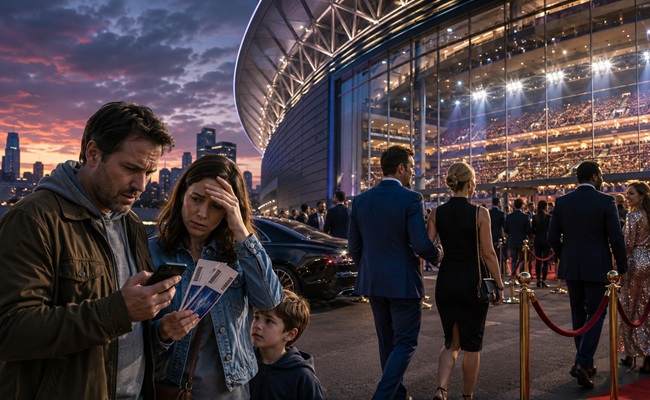
Now, the bigger worry is whether they can afford the ticket without damaging their life savings.
Welcome to the new golden age of entertainment ticketing, where watching a major sporting event or music concert is no longer just a leisure activity. It has become a financial decision, almost like buying property or investing in stocks.
The latest example comes from New York, where the NY Knicks’ return to the NBA Finals after 27 years has turned Madison Square Garden into the world’s most expensive temporary real estate.
According to The Wall Street Journal, some courtside tickets were listed for a shocking $176,000 each, while even regular seats were selling for thousands of dollars.
One pair of courtside tickets reportedly sold for nearly $280,000, approximately Rs 2.6 crore, enough to buy an apartment in many parts of the world.
Even the nosebleed seats high up in Madison Square Garden, where fans may need binoculars to clearly see the action, were selling for more than $4,000. One report said the cheapest ticket for an upcoming game was priced at $9,365, approximately Rs 8.8 lakh.
The issue became so serious that a reporter even brought it up before US President Donald Trump, saying ordinary Americans could not afford $8,000 tickets.
Trump’s response was blunt: “They can watch it on television. It’s sort of semi-free to watch it on television. But that’s the way life goes.”
Sports is only following a trend already created by the music industry. In the US, Taylor Swift’s Eras Tour turned concert tickets into a speculative asset. Fans did not just buy tickets; they practically arranged financing plans.
The Super Bowl, meanwhile, has become less of a sporting event and more of an annual gathering of the ultra-rich, celebrities and corporate elites.
Football’s World Cup is also moving in the same direction. Fans attending the 2026 tournament are expected to spend thousands of dollars once ticket prices, travel and hotel costs are added together. Matches are spread across cities in the US, Canada and Mexico, making the overall expense even higher.
Europe, once considered a safe space for affordable fandom, is no longer immune. The recent Champions League final featuring Paris Saint-Germain and Arsenal saw ticket prices shoot far beyond the reach of ordinary supporters.
Official tickets ranged from a few hundred euros to well over 1,000 euros, while secondary-market prices often ran into several thousands. The modern football fan is slowly beginning to look like a venture capitalist trying to enter an exclusive investment round.
The economics are simple. Demand is exploding, but supply is fixed. Taylor Swift can add more concerts, but not endlessly. Madison Square Garden cannot suddenly add 20,000 extra seats. FIFA cannot fit five million fans into a stadium built for 80,000.
When wealthy consumers, corporate buyers, celebrities, influencers, investment bankers and ordinary fans all chase the same limited number of tickets, capitalism does what it always does: it politely asks the poor to watch on television.
India has so far been relatively protected because of lower income levels and different pricing structures. IPL cricket tickets still remain far cheaper compared to major American sporting events.
But warning signs are already visible. The IPL’s growing corporate crowd, premium hospitality boxes, celebrity-driven demand and luxury match-day culture are slowly pushing ticket prices upward.
The biggest irony is that sports became a mass phenomenon because ordinary people could attend. Football was once a working-class pastime. Cricket grew through public grounds and local clubs. Basketball flourished in city neighbourhoods.
Today, the descendants of those same fans are increasingly being priced out of the very spectacles their earlier generations helped build.
Entertainment was once about passion. Now, it is becoming about purchasing power.