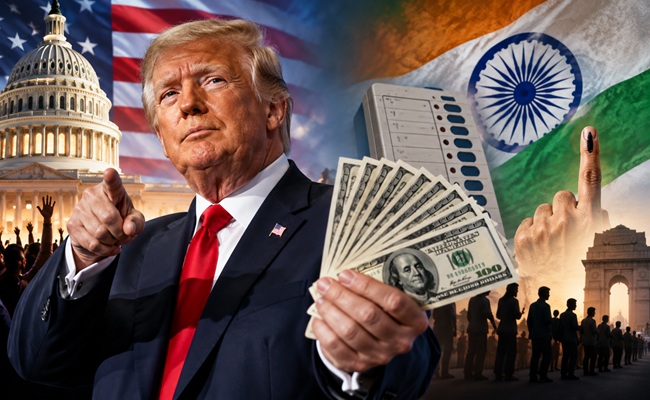
US President Donald Trump’s latest political moves are drawing comparisons with election strategies long familiar in India; tighter voter identification rules on one side and direct cash benefits on the other.
The comparison gained fresh attention after Trump promised a $5,000 “Trump dividend” to every adult American citizen if Republicans retain control of both the House and Senate in the November midterm elections.
Speaking at the Republican convention in Dallas, Trump urged supporters to “pretend” that he was on the ballot and linked the proposed payment directly to a Republican victory.
Trump said the payment would be issued if Republicans won both chambers of Congress.
With more than 200 million potentially eligible adults, such a programme could cost well over $1 trillion unless income limits or other eligibility conditions were imposed. No detailed funding mechanism has yet been announced.
The proposal has invited comparisons with direct-benefit politics in India, where both the central government and several state governments have increasingly used direct transfers and targeted welfare schemes.
India’s Direct Benefit Transfer system allows government benefits to be deposited directly into beneficiaries’ bank accounts.
State-level programmes such as Madhya Pradesh’s Ladli Behna and Maharashtra’s Ladki Bahin have also made direct financial assistance an important part of election-season political debate.
However, Trump’s proposed dividend differs significantly from such schemes. It is being presented as a broad payment to adult citizens rather than as a targeted welfare programme, and it would require congressional approval before it could become reality.
Voter ID: Another India Comparison
The second parallel involves voter identification.
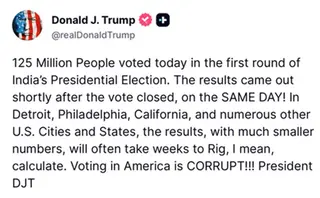
Trump has repeatedly pushed for stricter proof-of-citizenship and photo-identification requirements in US elections. In a March 2025 executive order on election procedures, he cited India and Brazil as examples of countries using stronger identity systems in their electoral processes.
He has also backed legislation seeking documentary proof of citizenship and government-issued photo identification for voting in federal elections.
India, however, does not rely exclusively on one identification document. While the Election Commission’s Electors Photo Identity Card, or EPIC, is widely used, voters can also present several other approved forms of identification. Aadhaar is not mandatory for voting.
The US system is also different because election administration is largely handled at the state level, and many states already have some form of voter-identification requirement.
Cash Plus Identification
What makes the comparison politically interesting is the combination of the two ideas: identifying eligible voters more strictly while also proposing a highly visible financial benefit directly to citizens.
In India, direct welfare programmes have increasingly allowed governments to make benefits more visible to recipients.
Trump’s proposed $5,000 dividend appears to follow a similar political logic, although the structure, legal framework and scale are quite different.
For now, the “Trump dividend” remains only a campaign proposal. No legislation detailing the programme, eligibility requirements or payment mechanism has been passed.
Still, the combination of stricter voter-ID demands and a direct cash promise has created an unusual parallel between US and Indian election politics; two very different democracies increasingly using some similar tools to reach voters.