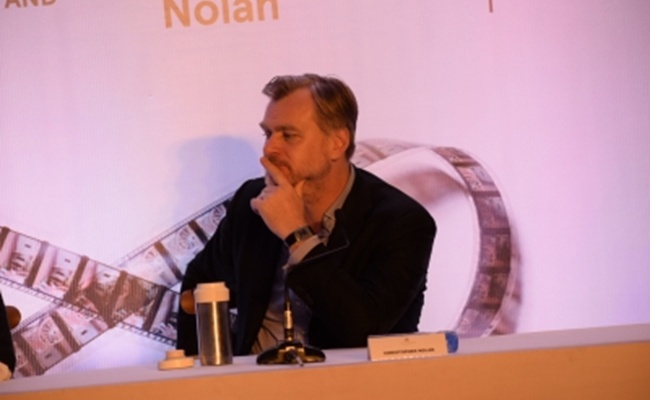
Christopher Nolan is one filmmaker whose work constantly reminds me that cinema doesn't need excess to create greatness.
Whether it is Interstellar or The Odyssey, he follows the same philosophy, keep the spectacle in service of the story, never the other way around.
While watching The Odyssey, I was struck by how natural everything felt. The action operated on a human scale. The battles weren't exaggerated for the sake of grandeur.
Every confrontation, every scuffle, and every clash felt believable because the emotions driving them were believable.
Nolan trusted the audience to engage with the characters rather than merely admire the scale of the visuals.
The same principle was evident years ago in Interstellar. Although the film explored black holes, distant planets, and space travel, what stayed with audiences wasn't the visual spectacle.
It was the emotional journey of a father and daughter, the weight of time, and the difficult choices people make. The visual effects enhanced the storytelling instead of overshadowing it.
This is where I believe many Indian filmmakers can rethink their approach.
For years, we've associated cinematic greatness with massive sets, gigantic armies, elaborate costumes, and extravagant battle sequences.
Films like Troy influenced this trend, which later found expression in films such as Jodhaa Akbar, Bajirao Mastani, Padmaavat, and Baahubali. These productions spent enormous budgets creating visual grandeur, in action sequences.
But we now live in the age of AI. Grand visuals, sprawling kingdoms, and endless armies can be created more easily and at a fraction of the cost. If technology can deliver spectacle cheaply, then spectacle alone cannot define greatness anymore.
The real challenge is to create action that feels authentic, emotionally charged, and dramatically convincing. That's where Nolan excels. He makes audiences care about the people before making them admire the visuals.
Indian cinema has already seen this philosophy succeed once. Ram Gopal Varma's Shiva revolutionized action by making it raw, grounded, and believable. Today's Telugu filmmakers can learn from that approach.
If S.S. Rajamouli eventually brings Mahabharata to the screen, I hope he prioritizes intelligence over extravagance. The epic's lasting appeal lies not in the sheer size of its battles but in its brilliant strategies, complex characters, and moral conflicts.
If those elements are presented with convincing, realistic action rather than excessive spectacle, the film would not only save resources but also earn something far more valuable than visual grandeur, a lasting respect.
Usha Chowdhary