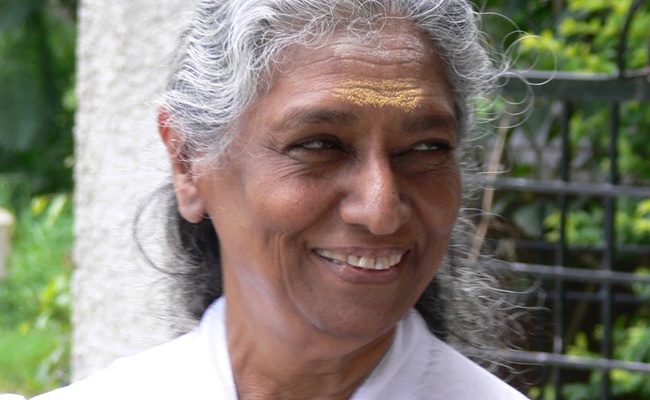
Legendary playback singer S Janaki, whose extraordinary voice shaped South Indian cinema for more than six decades, died on Saturday at a hospital in Mysuru. She was 88.
The veteran singer had been undergoing treatment for age-related health problems and reportedly suffered a cardiac arrest. Her death marks the end of an era in Indian film music.
Fondly known as “Janaki Amma,” she was loved by generations of listeners who had never met her but felt deeply connected to her voice. The tributes pouring in after her death read less like formal obituaries and more like a collective expression of gratitude.
Her voice possessed a rare versatility. She could sound like a child, a young bride, a heartbroken lover or an elderly grandmother, effortlessly adapting herself to the age, emotion and personality of the character on screen.
Born Sistla Janaki on April 23, 1938, in Pallapatla village in present-day Andhra Pradesh, she grew up without extensive formal training in classical music. Her early musical grounding came from local nadaswaram artist Paidiswamy, who recognised her talent when she was still performing on small village stages.
Her first major public recognition came in 1956, when she secured second place in an All India Radio light-music competition. Receiving the award from the President of India became a defining moment in her early life and convinced her family that music could become a serious career.
Encouraged by her uncle, Janaki moved to Chennai, then the centre of South Indian film production. She joined AVM Studios under composer R Sudarsanam and made her playback singing debut in the 1957 Tamil film Vidhiyin Vilayattu.
Her rise was remarkably swift. During her debut year itself, she recorded songs in several languages, including Telugu, Malayalam and Kannada. It was an early indication of the talent that would later define her career: an exceptional ability to master unfamiliar languages, accents and emotional expressions.
Over the next six decades, Janaki recorded tens of thousands of songs in numerous Indian and foreign languages. Her vast repertoire included Tamil, Telugu, Kannada, Malayalam, Hindi, Odia, Bengali, Punjabi, Tulu and Sanskrit, among others. She is widely credited with recording more than 40,000 songs, though estimates vary.
A Voice That Ruled Four Film Industries
Unlike many playback singers whose success was concentrated in one language, Janaki simultaneously dominated the Tamil, Telugu, Kannada and Malayalam film industries.
In Kannada cinema, where she recorded a significant share of her songs, she became one of the industry’s most dependable female voices. She worked extensively with composers such as G K Venkatesh, Rajan–Nagendra and Hamsalekha, while her songs associated with Dr Rajkumar became enduring favourites.
In Malayalam cinema, she emerged as one of the most sought-after female playback singers of her generation. Despite not being a native Malayalam speaker, her pronunciation and emotional depth earned her widespread admiration. Composers including V Dakshinamoorthi, M S Baburaj and Salil Chowdhury relied on her voice for romantic melodies, devotional songs and deeply emotional numbers.
Her influence in Telugu and Tamil cinema grew dramatically during the 1970s. In Telugu, she won multiple Nandi Awards and became the voice behind countless memorable songs.
Her Tamil career reached remarkable heights through her long association with composer Ilaiyaraaja and singer S P Balasubrahmanyam. Together, they created some of the most beloved songs of the late 1970s, 1980s and 1990s.
Janaki also made her presence felt in Hindi cinema. Composer Bappi Lahiri, impressed by one of her Hindi recordings for a South Indian film, introduced her to Bollywood, where she sang alongside leading artists, including Kishore Kumar.
Her collaboration with a young A R Rahman during the 1990s introduced her voice to another generation of music lovers. Even in the fifth decade of her career, she continued to deliver award-winning performances, underlining her exceptional longevity.
Honours, Awards and a Historic Refusal
Janaki received four National Film Awards for Best Female Playback Singer and more than 30 state government awards across Andhra Pradesh, Tamil Nadu, Kerala and Karnataka.
She was also honoured with an honorary doctorate from the University of Mysore and received lifetime achievement awards from organisations including Filmfare and SIIMA.
However, she is remembered almost as much for an honour she declined as for those she accepted.
In 2013, Janaki refused the Padma Bhushan announced by the Government of India. She said the recognition had come too late and expressed disappointment over what she believed was the continued neglect of artists from South India in the national awards system.
Her decision reflected the same independence and conviction that defined her artistic life.
Retirement on Her Own Terms
Janaki gradually stepped away from playback singing around 2016–17. She had often said that she wanted to retire while her voice remained recognisable and before age forced her to withdraw.
It was a fitting decision for a singer who had always maintained complete control over her craft.
Although her career began decades before the digital and streaming era, her songs continue to attract new listeners. Younger audiences regularly discover her music through digital platforms, remastered albums and curated retrospectives.
Her enduring popularity proves that a voice capable of communicating emotion across languages needs no translation.
S Janaki was not merely a singer interpreting a composer’s tune. She became an essential part of a film’s emotional life, giving characters tenderness, innocence, desire, grief, humour and strength.
As Indian cinema mourns one of its greatest musical voices, Janaki Amma’s songs will continue to live on—carrying memories across languages, generations and time.