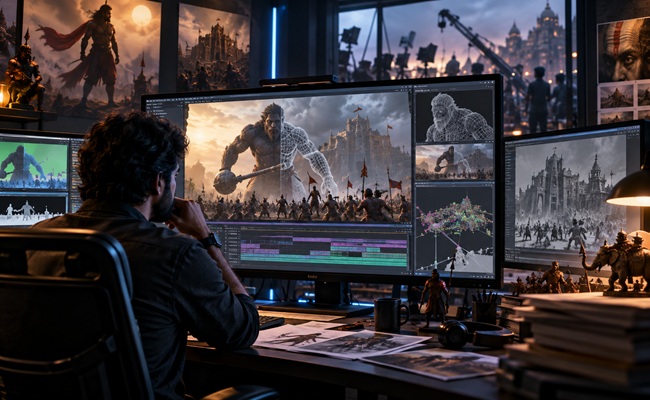
Three letters are increasingly becoming a headache for filmmakers trying to stick to their release dates: VFX.
Visual effects have become a crucial part of big-screen spectacles, but the time required to create, review and perfect them can throw entire production schedules off track.
Films such as Hanuman Ansh and Irumudi, despite dealing with divine or larger-than-life elements, did not rely heavily on VFX and managed to reach theatres on time with relatively controlled budgets.
The real trouble begins when the VFX output does not meet the filmmakers’ expectations.
A sequence may take days or even months to complete, only to be rejected and sent back for a complete rework. That means another long wait, pushing the film further away from its planned release date.
Despite the amount of money being spent, achieving consistently high-quality VFX remains a challenge for many companies.
This puts major productions such as Fauzi, Vishwambhara and Varanasi under enormous pressure. As deadlines approach, filmmakers may be forced to settle for minor tweaks instead of demanding complete reworks.
The consequences can sometimes be visible on screen, with Hari Hara Veera Mallu becoming a talking point among audiences for its much-criticised visual effects.
Artificial intelligence could eventually reduce some of this burden, but the technology is not yet advanced enough to replace sophisticated VFX workflows.
Until quality, infrastructure and turnaround times improve, those three letters; VFX; could continue deciding when films actually make it to theatres.