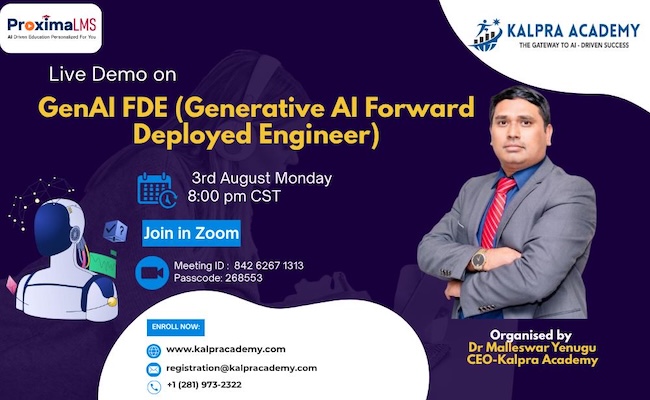
Registration Link: Please fill out this Google Form to register: https://forms.gle/MnuedbA8dDtMdpWC8
LIVE Demo Details:
Please join our LIVE demo today to learn more about our upcoming course starting next week.
- Zoom Link: https://us06web.zoom.us/j/84262671313?pwd=pgvk54Ff77jSV1KFZXcJSo7K3wyk4q.1
- Meeting ID: 842 6267 1313
- Passcode: 268553
Course Content: AI Forward Deployed Engineer (FDE)
Study Pace: 60-90 Mins / Day | Duration: 16 Weeks
1) Course Prerequisites
- Core Programming Logic: Proficiency in object-oriented Python, foundational data structures (dictionaries, lists, sets), functions, and robust exception handling.
- Version Control & Terminal: Ability to navigate standard Linux/Unix CLI environments and execute fundamental Git commands (commit, push, branch, merge).
- Web & Network Fundamentals: Comprehension of client-server architecture, RESTful APIs, HTTP methods (GET, POST), JSON data parsing, and secure environment variable management.
2) The 16-Week Curriculum
- Week 1: Robust Backends & Rapid Interfaces
- Focus: Write clean Object-Oriented Python code, build asynchronous FastAPI endpoints, and implement Pydantic schema validation.
- Database: Design a persistent SQLite schema and configure an Object-Relational Mapper (ORM) to securely store user sessions and application logs.
- Output: A fully functional REST API connected to a structured SQLite database, visualized through a responsive Streamlit frontend.
- Week 2: Commercial LLM Integration & Prompt Engineering
- Focus: Interface with frontier models (GPT-4o, Claude) using non-blocking asynchronous network calls.
- Prompting: Master system prompt engineering, few-shot formatting, and enforce strict, predictable outputs using JSON schema validation.
- Output: A resilient API wrapper featuring exponential backoff retry logic, automated token counting, and validated JSON data extraction.
- Week 3: Open-Source Models & Local Inference
- Focus: Deploy private, highly efficient small language models (SLMs) on local edge or on-premise hardware.
- Inference: Configure the Ollama runtime, manage model quantizations, optimize memory allocation, and control context windows.
- Output: A localized, offline inference microservice seamlessly integrated into your primary backend architecture.
- Week 4: Text Embeddings & Vector Databases
- Focus: Master vector space mathematics, high-dimensional distance metrics, and cosine similarity scoring.
- Chunking: Implement advanced fixed-size, recursive, and semantic chunking strategies for parsing large enterprise documents.
- Output: A persistent vector store setup capable of indexing custom text corpora for rapid similarity retrieval.
- Week 5: Foundational RAG & Persistent Chat Memory
- Focus: Construct a sophisticated document retrieval pipeline that dynamically injects client data into LLM context windows.
- Memory: Engineer a schema mapping unique session IDs to persistent SQLite chat histories to maintain conversational continuity.
- Output: An intelligent document Q&A vault featuring multi-turn memory that eliminates the need for repetitive file uploads.
- Week 6: Advanced Retrieval Architectures
- Focus: Upgrade semantic search to Hybrid Search by fusing BM25 exact-keyword matching with dense vector embeddings.
- GraphRAG: Implement entity-relationship knowledge graphs to achieve deep, interconnected enterprise document understanding.
- Output: A self-correcting retrieval pipeline utilizing Cohere reranking for ultra-high-precision context extraction.
- Week 7: Autonomous Tool Calling & Function Execution
- Focus: Empower LLMs to autonomously trigger external Python functions, query SQL databases, and interact with third-party REST APIs.
- Execution: Handle dynamic argument generation, parse strict schema requirements, and establish secure sandbox execution environments.
- Output: A functional AI agent capable of writing and executing Python scripts and querying database records to resolve user inquiries.
- Week 8: Model Context Protocol (MCP) Integration
- Focus: Standardize connections between enterprise data sources and internal tools using the open Model Context Protocol.
- Architecture: Build robust custom MCP servers and client adapters to guarantee seamless interoperability across multi-agent systems.
- Output: A custom MCP server that securely exposes localized enterprise data and proprietary internal tools universally to LLM clients.
- Week 9: Agentic Workflow Design & State Management
- Focus: Architect non-linear AI systems capable of strategic planning, self-evaluation, and conditional routing.
- State: Maintain highly structured application state across complex, long-running, multi-step execution graphs.
- Output: A stateful, autonomous agent capable of decomposing massive, complex objectives into manageable, dynamic sub-tasks.
- Week 10: Deep Dive into LangGraph
- Focus: Construct resilient cyclic workflows utilizing defined nodes, edges, and state channels within the LangGraph framework.
- Self-Correction: Implement algorithmic reflection loops allowing agents to critically evaluate their own outputs and iteratively retry upon failure.
- Output: A production-grade LangGraph workflow incorporating explicit human-in-the-loop intervention breakpoints.
- Week 11: Multi-Agent Collaboration & Orchestration
- Focus: Orchestrate hierarchical teams of specialized AI agents assigned distinct enterprise roles (e.g., Lead Researcher, Technical Editor, Auditor).
- Delegation: Design robust protocols for task hand-offs, shared memory context management, and cross-agent consensus mechanisms.
- Output: An autonomous multi-agent research crew that flawlessly collaborates to generate comprehensive, multi-page market analysis reports.
- Week 12: LLMOps, Observability & Evaluation
- Focus: Implement real-time tracking, tracing, and granular debugging of non-deterministic multi-agent execution paths.
- Metrics: Monitor financial token expenditure, system execution latency, and deploy automated continuous performance evaluation models.
- Output: A comprehensive telemetry tracing pipeline integrated with LangSmith, featuring automated LLM-as-a-Judge hallucination scoring.
- Week 13: Containerization & Cloud Deployment
- Focus: Package multi-container AI microservices to guarantee absolute operational parity between local development and cloud deployment environments.
- Infrastructure: Dockerize core FastAPI backends, distinct vector databases, and localized Ollama runtimes via Docker Compose configurations.
- Output: A scalable, fully containerized deployment pipeline explicitly primed for seamless enterprise cloud hosting.
- Week 14: Enterprise AI Security & Guardrails
- Focus: Defend critical client systems against sophisticated prompt injection attacks, LLM jailbreaks, and sensitive enterprise data exfiltration.
- Hardening: Enforce rigorous input/output guardrails, mandate strict Pydantic JSON schema validation, and implement secure secret key rotation.
- Output: A hardened, battle-tested security layer capable of intercepting toxic inputs and blocking unauthorized database access attempts.
- Week 15: Legacy System Coexistence & Performance Optimization
- Focus: Architect modern enterprise AI solutions engineered to connect securely and seamlessly to outdated legacy monolith systems without inducing operational disruption.
- Performance: Deploy high-speed semantic caching mechanisms utilizing Redis to drastically reduce LLM API latency and minimize ongoing cloud expenses.
- Output: A comprehensive enterprise system architecture document detailing a highly stable hybrid integration strategy.
- Week 16: Scoping & Consulting (The FDE Capstone)
- Focus: Master the art of translating ambiguous executive business problems into explicitly defined technical requirements and rigorous system specifications.
- Delivery: Finalize an end-to-end production prototype seamlessly combining RAG architecture, autonomous tool calling, multi-agent workflows, and containerized cloud deployment.
- Output: A live, battle-tested Forward Deployed AI system accompanied by a highly professional technical client demonstration portfolio.
3) Post-Course Outcomes
- Autonomous Systems Engineering: You will acquire the technical proficiency to design, build, critically evaluate, and securely deploy self-correcting multi-agent systems and sophisticated GraphRAG pipelines capable of resolving real-world enterprise bottlenecks.
- Production & Infrastructure Mastery: You will confidently containerize and deploy complex AI applications into active cloud or on-premise environments, ensuring complete system observability, rigorous secret management, and adherence to OWASP-compliant security guardrails.
- Enterprise Bridge (Code & Business): You will develop the rare capability to lead technical discovery calls, accurately diagnose deep operational bottlenecks, architect highly customized AI solutions, and flawlessly execute the entire production pipeline from initial code commit through to final client deployment.
For More info, please reach us at: https://kalpracademy.com/
Mail at [email protected]
Call: +1-281-973-2322
Please fill out this Google Form to register: https://forms.gle/MnuedbA8dDtMdpWC8
Content Produced by Indian Clicks, LLC