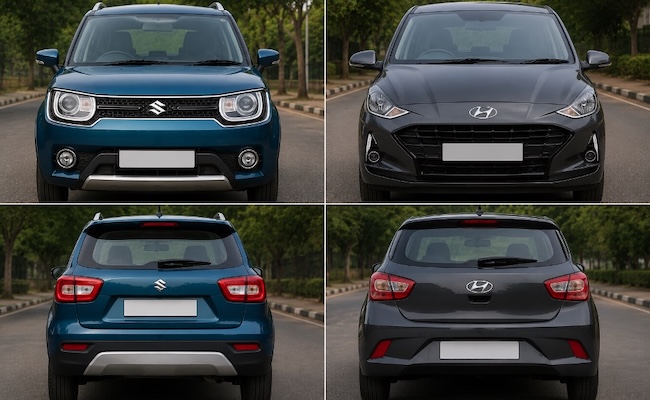
The Maruti Ignis and the Hyundai Grand i10 Nios frequently end up on the same shortlists in the used market, they share a price band (roughly ₹4-7 lakh for decent examples), they're both urban-oriented, sub-4-metre hatchbacks, and they both have established service networks.
But as cars, they are genuinely quite different in what they prioritise, how they feel to live with, and who they're actually suited for. Understanding these differences before you test drive either is what makes the comparison useful rather than confusing.
Exploring used Suzuki Ignis listings alongside the second hand Hyundai Grand i10 Nios shows you the current price bands for each, which is the right anchor for any negotiation.
The Maruti Ignis
The Ignis is a car with a specific identity. It was positioned as a premium urban hatchback with SUV-inspired styling cues, a taller stance, squared-off proportions, and 180mm of ground clearance, at a time when Maruti wanted to address buyers who wanted something more distinctive than the conventional hatchback aesthetic.
The result was a car that looks different from anything else on Indian roads (there's genuinely nothing quite like an Ignis in the market), has a cabin that felt quality-focused for its segment, and drives with a precision and lightness that rewards urban use.
The engine is a 1.2-litre K12B Dualjet petrol making around 83ps, paired with a 5-speed manual or a 5-speed AMT. Fuel economy is strong, 20+ km/l is achievable in consistent mixed driving. The Ignis was available in four trim levels (Sigma, Delta, Zeta, Alpha), with the Alpha featuring leather upholstery, auto-climate control, and a touchscreen infotainment system.
The Ignis was discontinued in India in 2023, which means the used market is the only place to get one now. Maruti's parts supply for recently discontinued models is generally good for the near to medium term, the K12 engine family is used across multiple platforms, so consumables are accessible. The more Ignis-specific components (body panels, specific trim pieces) will become harder to source over time, which is a factor to weigh for long-term ownership.
The Hyundai Grand i10 Nios
The Grand i10 Nios is a very different kind of car. Where the Ignis is quirky and character-led, the Nios is competent and comprehensive. The 1.2-litre Kappa petrol (83ps) with its 4-cylinder layout is smoother and quieter at idle than the Ignis's 4-cylinder (notably less NVH), and the car's conventional hatchback proportions mean more practical rear headroom and a more accommodating rear bench for three adults.
Feature content in the Nios is strong, the top Asta trim came with a 20.32-cm touchscreen, wireless charging, a cooled glove box, and Hyundai's BlueLink connected car suite. A factory CNG option is also available, which opens up the fuel economy conversation significantly in cities where CNG infrastructure is reliable.
Service and parts availability is a clear Nios advantage, Hyundai's network is extensive, the car remains in production, and every component is actively manufactured.
For buyers who want the most eclectic, design-distinct, and driving-enjoyable option in the segment, and who are comfortable with the discontinuation reality, a used Suzuki Ignis in Alpha trim is a genuinely enjoyable used car proposition.
The daily living trade-offs are also worth understanding in each case. The Ignis's tall-boy body gives it surprisingly good headroom despite its compact footprint, a feature that works particularly well in Indian urban conditions where adults of varying heights share small cars.
The ground clearance of 180mm means the Ignis genuinely clears obstacles that lower-riding hatchbacks scrape on, which is a tangible daily-use advantage in cities where road conditions vary dramatically within the same commute.
The Grand i10 Nios's CNG variant is a specific recommendation for buyers in cities where CNG infrastructure is reliable. Hyundai's factory-fitted CNG maintains full warranty coverage, doesn't compromise the spare wheel, and delivers fuel economy in CNG mode that makes the running cost argument very compelling.
For high-mileage urban commuters, the Nios CNG's economics over three to five years of ownership can represent savings that dwarf the difference in purchase price between it and any petrol alternative at this price point.
For buyers who prioritise practicality, cabin comfort, long-term parts peace of mind, and feature content, the second hand Hyundai Grand i10 Nios in Sportz or Asta trim delivers more of those attributes at comparable prices.
One more factor: community and parts ecosystem. The Ignis has a cult following among urban driving enthusiasts, which means active community groups, aftermarket support, and owners willing to share knowledge about maintenance and modification. The Nios has a larger installed base, meaning more familiar mechanics and faster parts procurement, advantages that compound across years of ownership.
These are not competitors in the traditional sense, they cater to genuinely different buyer temperaments. Know which temperament you are, and the choice becomes straightforward.
Content Produced by Indian Clicks, LLC