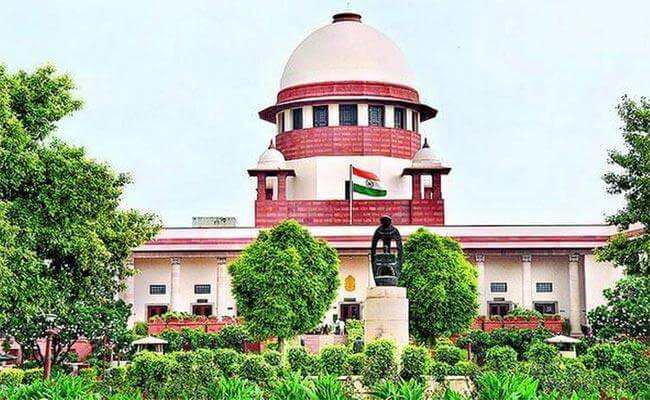
The Supreme Court has pulled up the Andhra Pradesh government over its decision to engage outsourced personnel in various Special Magistrate Courts across the state.
A bench comprising Justices Aravind Kumar and V. M. Pancholi was hearing a petition filed by 113 temporary employees working in Special Magistrate Courts who are seeking regularisation of their services. During the hearing, the Bench asked the government whether even the post of Chief Secretary could similarly be outsourced.
On Monday, the Bench directed the Andhra Pradesh High Court and the state government to take an appropriate decision on the issue within two weeks.
Senior advocate Dama Seshadri Naidu, appearing for the petitioners, told the court that after the bifurcation of the erstwhile united Andhra Pradesh, the Telangana High Court had regularised the services of similarly placed contractual employees.
He submitted that although a petition filed earlier by around 100 such employees had been dismissed by the Supreme Court, the Telangana High Court subsequently took a different view and regularised their services.
The counsel argued that all employees appointed under the same government order should be treated alike and requested the Supreme Court to ensure that the same benefit was extended to the petitioners.
The submissions prompted the Bench to seek an explanation from the counsel appearing for the Andhra Pradesh High Court.
When the counsel described the posts as temporary outsourcing positions, Justice Aravind Kumar questioned the rationale behind outsourcing such posts.
The judge asked why the positions needed to be outsourced and whether the government would also consider outsourcing the Chief Secretary’s post.
The court observed that outsourcing was generally associated with certain support positions such as peons and drivers, while the petitioners had reportedly been working for around 15 years.
The judge said that if the existing government policy prevented their regularisation, the policy itself could be reconsidered.
The Bench observed that it could issue an order directing regularisation but suggested that the government should take the initiative and resolve the matter through an appropriate policy decision.
The counsel appearing for the High Court sought some time to examine the issue.
Senior advocate Seshadri Naidu then submitted that the state government was not opposed to regularising the employees and that the objection was essentially coming from the High Court.
The Bench subsequently questioned state government counsel Prerana Singh about the government’s position and asked why the government appeared to be taking a different approach from the High Court.
The counsel replied that the government was acting in accordance with whatever the High Court had directed.
Justice Aravind Kumar then questioned how the authorities could differentiate between employees when around 100 similarly placed personnel had already been regularised.
The judge observed that the employees were low-paid workers and that regularisation would provide them with greater stability in life.
He also referred to the personal circumstances of women employees, observing that job security could help them attain greater stability.
The government counsel sought additional time to obtain the state’s response and place it before the court.
The Bench agreed and adjourned the matter, directing the authorities to return within two weeks with a draft policy on the issue.