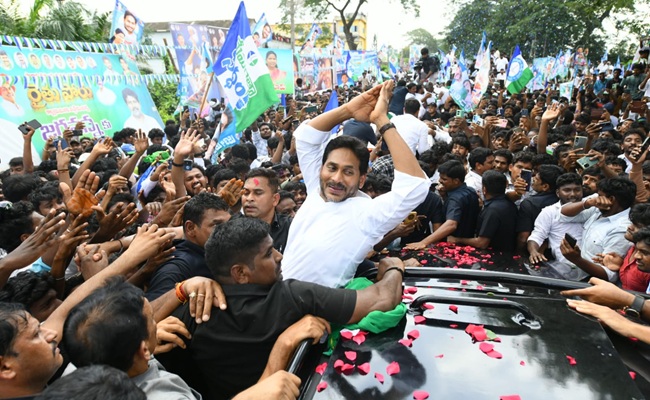
Y S Jagan Mohan Reddy’s public appearances are once again drawing massive crowds, particularly among Gen Z supporters who enthusiastically surround him wherever he travels.
Such scenes have become increasingly common in recent weeks, raising questions over whether the political atmosphere in Andhra Pradesh is beginning to change.
The visible enthusiasm among young supporters has surprised many political observers.
When the alliance government came to power, several YSRCP leaders and supporters faced arrests and legal action. There was also a perception that many party workers were reluctant to participate openly in political activities out of fear.
However, the recent turnouts suggest that those fears may be gradually fading. The question now being raised is whether concerns over arrests and attacks have diminished, encouraging supporters to come out in larger numbers.
The gathering for Jagan at Devarapalli in East Godavari district drew particular attention. The district is widely considered a weak region for the YSR Congress Party. Yet, the turnout for Jagan’s visit was substantial and caught many observers by surprise.
While critics often claim that such crowds are mobilised with money, supporters argue that participation on this scale reflects genuine enthusiasm rather than financial inducement.
Political analysts believe that crowd size alone cannot predict election outcomes. At the same time, consistently large gatherings cannot be dismissed. They often indicate the public mood and a leader’s ability to reconnect with the people.
The growing presence of young people at Jagan’s events is being viewed as a significant development that deserves close observation rather than outright dismissal.
There is also increasing discussion about signs of anti-incumbency against the alliance government, even though it is only halfway through its term. Public dissatisfaction over local issues, combined with the opposition’s efforts to mobilise supporters, appears to be creating a changing political landscape in some regions.
Whether this sentiment will translate into votes remains to be seen.
For the alliance leadership, this may be a time for introspection rather than complacency. Assuming that crowds will not convert into electoral support could prove to be a risky calculation if public sentiment continues to shift.
Identifying the areas where anti-incumbency is growing and taking timely corrective measures could be crucial to maintaining political strength in the years ahead.