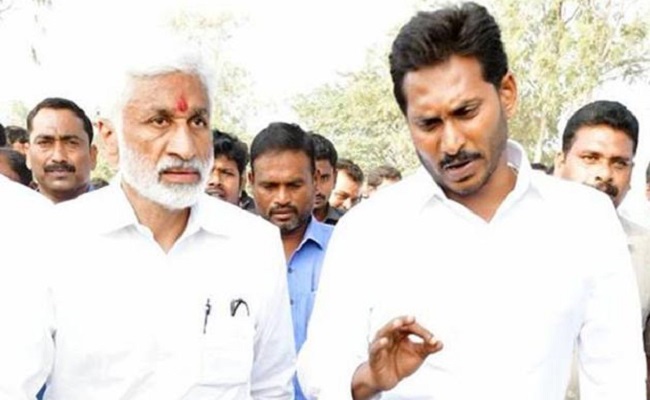
Vijaysai Reddy’s sudden embrace of a strong Hindutva agenda is, to put it mildly, jaw-dropping.
After spending more than a decade with Y S Jagan Mohan Reddy and serving as a prominent YSRCP leader and Rajya Sabha member, his aggressive stand on religious conversions has naturally triggered questions: if conversions were such a serious concern, why did he remain silent for so many years?
Many are now questioning his timing and credibility along precisely these lines.
One pointed question doing the rounds is; “If Jagan promoted religious conversions, you were with the party from 2014 to 2024 and served two terms in the Rajya Sabha. Did he ever ask you to convert your religion?”
Another question is even more direct; “If conversions were being encouraged, why has not even one person, during all these years or even now, filed a police complaint alleging that Jagan forced or encouraged them to convert?”
These questions gain importance in the context of the Pithapuram tragedy.
The incident involving Panchayat Raj Assistant Engineer Nookaraju and his family has reportedly been linked to a family dispute, with no established Hindu-Muslim angle.
If that is indeed the case, then Sai Reddy’s immediate attempt to connect the episode with religious politics appears to have been an exercise in haste. What was presented as a major religious issue could ultimately turn out to be completely unrelated to conversions.
Supporters of Jagan have responded angrily, arguing that attacking him with “conversion” allegations has become a political fashion.
One such reaction summed up the sentiment bluntly; “Everyone attacking Jagan with false allegations about religious conversions has made it a big fashion.”
Another accused former associates of discovering political courage only after leaving power.
There is also a broader political argument emerging from these reactions; Jagan may have made a fundamental mistake in whom he trusted and promoted.
Critics point out that several leaders who enjoyed enormous access, power, influence and political importance under him eventually turned against him.
Meanwhile, many ordinary party workers and leaders who remained loyal without seeking wealth, power or prominent positions are still emotionally attached to him, but not getting recognized by party high command.
The names of Y V Subba Reddy, Balineni Srinivasa Reddy and Vijay Sai Reddy are frequently mentioned in this debate.
Critics argue that the political handling of these leaders damaged the YSRCP’s image in their respective regions, with Sai Reddy facing particular criticism for the party’s decline in North Andhra.
Another widely expressed view is that Jagan repeatedly gave disproportionate value to people who ultimately proved politically unreliable or ineffective.
As one supporter put it; “Jagan promoted the wrong people; those he trusted have backstabbed him.”
The political irony, therefore, is difficult to ignore. Vijay Sai Reddy’s new Hindutva positioning may create headlines, but it also revives an uncomfortable question that if these convictions were genuinely held, why were they not voiced with equal force when he was sitting beside Jagan?
For many observers, that question may prove harder to answer than the allegations themselves.