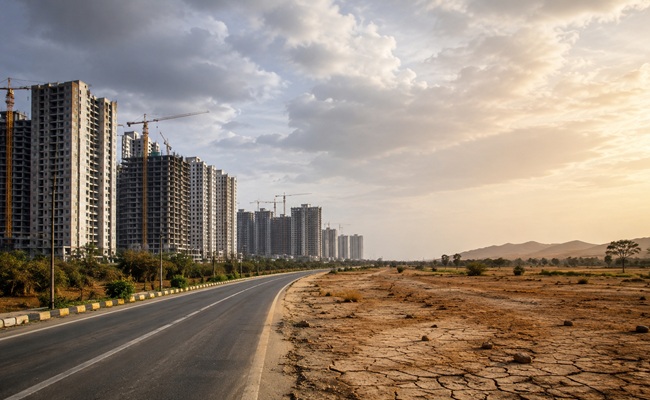
Real estate has always reflected the economic confidence of a region. Growth in land values, housing demand and commercial activity usually follows infrastructure development, employment generation and investment—not merely announcements.
After the bifurcation of Andhra Pradesh in 2014, Telangana retained Hyderabad as its undisputed real estate powerhouse. Historically, Hyderabad has continued to expand in all directions, attracting investors, businesses and homebuyers.
Cities such as Warangal and Nizamabad remain important urban centres, but their real estate growth has largely been local. They have never generated the kind of statewide investment momentum that Hyderabad consistently enjoys.
Most other towns across Telangana have remained relatively underdeveloped in terms of large-scale real estate activity. Their growth has been gradual and limited, without significantly influencing the state’s property market.
In Andhra Pradesh, the situation has been different.
During Chandrababu Naidu’s first term from 2014 to 2019, Amaravati was projected as a future world-class capital. The vision generated enormous expectations among investors.
Thousands invested in land believing that Amaravati would become the state’s biggest real estate destination. However, apart from perception-building, road construction, a few government buildings and land pooling by farmers, the expected boom never truly materialised.
During Naidu’s tenure between 2014 and 2019, real estate ventures around Tirupati also attracted strong investor interest. Many investors from Hyderabad purchased land in the region, believing that his vision and governance would trigger a major property boom across Andhra Pradesh.
The change of government in 2019 weakened Amaravati’s prospects. The three-capital proposal briefly shifted investor attention towards Visakhapatnam and Kurnool, creating temporary real estate activity in those cities. However, that momentum eventually faded.
Andhra Pradesh has several prominent commercial cities, including Visakhapatnam, Vijayawada, Guntur, Rajahmundry, Nellore and Tirupati. Despite their economic importance, none has witnessed a sustained, large-scale real estate surge.
Even after the change of government in 2024, with Chandrababu Naidu returning as Chief Minister, there has been little visible improvement in the state’s property sector. Amaravati has also not experienced the revival that many had expected.
The slowdown in the global economy has further affected investor sentiment, making people more cautious about large investments.
This raises a fundamental question: can investment alone create lasting real estate growth?
The experience of Kia Motors in Anantapur offers an interesting example. Although the automobile plant created jobs, it did not trigger the kind of surrounding property boom that many had anticipated.
Around Rs 15,000 crore in tax incentives was reportedly extended to the company. However, this did not result in aggressive employment generation or a significant real estate boom in the surrounding region.
Had a similar amount been invested in large-scale infrastructure development, it might have created a more organic and sustainable property boom with wider economic benefits.
The main reason for this slowdown is the lack of strong supporting infrastructure.
Many professionals associated with Kia continue to prefer living in Bengaluru because of its better urban facilities and connectivity. Instead of permanently relocating to Anantapur, they often commute or maintain their base in Bengaluru.
The lesson appears clear. Sustainable real estate growth requires world-class infrastructure before major investments can transform a region.
If governments cite a lack of funds, questions naturally arise about public spending priorities.
Welfare expenditure today is not as aggressive as it was during the previous YSRCP government, yet public debt continues to rise. If borrowed funds are not translating into visible infrastructure, the future of Andhra Pradesh’s real estate sector will remain uncertain.