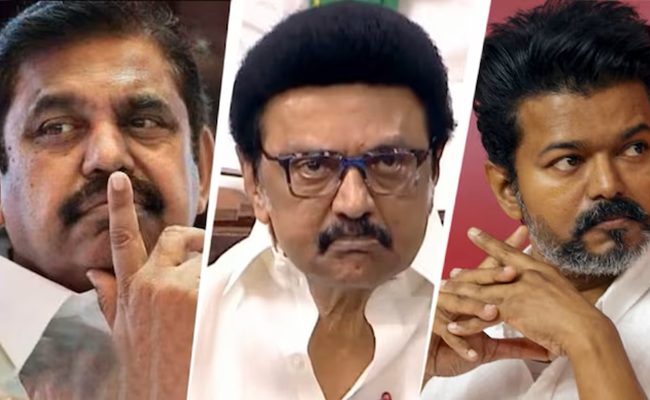
Four days after the Assembly election results, Tamil Nadu is still facing political uncertainty.
The state has a hung Assembly, a Governor who is yet to invite the single largest party to form the government, and two traditional rivals who are reportedly exploring options to keep a newcomer away from power.
The verdict has shaken six decades of Dravidian politics. Vijay’s TVK won 108 seats, more than the DMK and AIADMK combined. Yet, the road to government formation remains complicated. At present, five possible scenarios are being discussed in political circles.
Scenario 1: President’s Rule And Fresh Election
If no party or coalition can prove majority support before Governor R V Arlekar, he may recommend President’s Rule. This could be extended in six-month blocks and may eventually lead to a fresh election, possibly before the end of 2026.
For TVK, this may not be the worst option. The party won big on a record 85.1% voter turnout, and if it is seen as being denied power despite emerging as the single largest party, a sympathy wave could further strengthen Vijay’s mandate.
For the DMK and AIADMK, however, a re-election could be risky. They would have to face voters again after being seen as part of a backroom arrangement against the verdict.
Scenario 2: DMK-AIADMK Patchwork Coalition
The DMK has 59 seats and the AIADMK has 47. Together, they reach 106, still 12 short of the majority mark of 118.
To cross the line, they would need the support of several smaller parties, including the Congress, VCK, Muslim League, CPI, CPI-M, DMDK and AMMK. This could take the tally to around 121.
But this arrangement has major problems. First, some smaller parties are ideologically uncomfortable sharing space with each other.
Second, every small party will come with its own demands. One unhappy leader or one dissenting MLA could bring down the entire setup.
Such a coalition may cross the numbers on paper, but surviving in power could be much harder.
Scenario 3: TVK Plus A Split In AIADMK
The most dramatic route for Vijay could come through a split in the AIADMK.
Under the anti-defection law, at least 34 of the AIADMK’s 47 MLAs would need to break away to claim a valid two-thirds split. If that happens, TVK could get a comfortable working majority.
Tamil Nadu politics has seen dramatic splits and realignments in the past. But the question is whether such a move can happen quickly.
AIADMK MLAs are reportedly being kept together under EPS’s watch, and the window for a split may be narrowing.
The bigger question is whether the Governor will wait long enough for the numbers to change or take a decision before that.
Scenario 4: TVK Builds A Coalition
TVK can also try to build its own coalition with smaller parties.
One route is to bring in the PMK, DMDK and AMMK. This could take TVK from 108 to 119, just above the majority mark. But the PMK has already reportedly demanded the Deputy Chief Minister post as its price for support.
Another route is to get the support of the Left parties and the Muslim League. That could take the number to 123. But this path appears difficult for now, as the Left, Muslim League and VCK are said to be committed to the DMK camp.
This leaves Vijay negotiating with smaller regional players, whose support may come with heavy portfolio demands and constant political pressure. For a first-time party, managing such a coalition would be a major test.
Scenario 5: TVK’s Mass Resignation Threat
The most extreme option before TVK is mass resignation.
If all TVK MLAs resign together, it could trigger a major constitutional and political crisis. The move would send a strong message that the party will not accept being bypassed despite winning the highest number of seats.
Such a step could put pressure on the Governor, the judiciary and the national political system. But it also carries risk. Critics may say TVK is abandoning the same voters who elected its MLAs.
Whether Vijay and his MLAs are ready for such a drastic step remains to be seen.
What Happens Next?
Tamil Nadu’s political crisis is unlikely to end quietly. The DMK has authorised M. K. Stalin to take urgent political decisions.
The AIADMK is reportedly keeping its MLAs together. Vijay has already met the Governor more than once, but has still not been invited to form the government.
Every passing day without a solution strengthens the possibility of President’s Rule. It also weakens the moral claim of any government formed by excluding the party that won the highest number of seats.
Tamil Nadu’s voters have already given their verdict. Now, the political class is deciding whether to respect it or rewrite it through post-poll arithmetic.