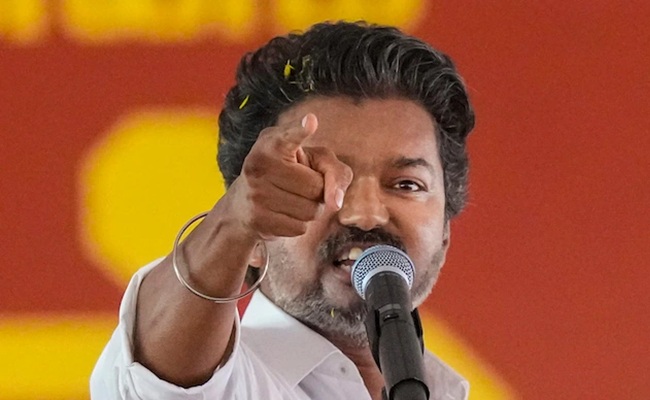
When C. Joseph Vijay announced his political entry in Tamil Nadu, reactions were not limited to that state. In Andhra Pradesh too, some caste groups quickly responded, even putting up flex banners.
It is common to see people here trying to find out the caste of anyone who becomes popular, no matter where they are in the world.
We have seen this many times. If someone achieves something big, people immediately start tracing their caste background.
When shooter Manu Bhaker won an Olympic medal, some groups claimed her as their own and even made social media posts about it.
Similarly, in 2014, some groups in AP claimed that Prime Minister Narendra Modi belongs to their caste.
Now the same discussion is happening around Vijay. Some groups are trying to “own” him.
Based on his full name, some say he is Christian. But if you look at his family background, his father’s name and his mother’s lifestyle do not clearly indicate that.
It is also said that when Vijay was admitted to school, his father mentioned “Tamil” in the caste column, showing a broader identity rather than a caste label.
Despite this, people are not stopping. Some claim Vijay belongs to the Madiga community, while others argue he is from an OBC background.
There are even discussions linking his ancestry to Tamil roots from regions like Chittoor, with different interpretations based on family names. Everyone seems to have their own theory.
But the bigger point is this — Vijay himself never spoke about his caste during the election campaign. He never asked for votes in the name of caste.
He did not project himself as belonging to any particular community, nor did he target opponents on caste lines.
Instead, he stayed away from such low-level politics and focused on his campaign, eventually emerging successful. That is something many people are not noticing.
Even after the results, the focus for many is still on his caste, rather than his political journey.
In the end, the debate says more about the mindset of those discussing it than about Vijay himself.