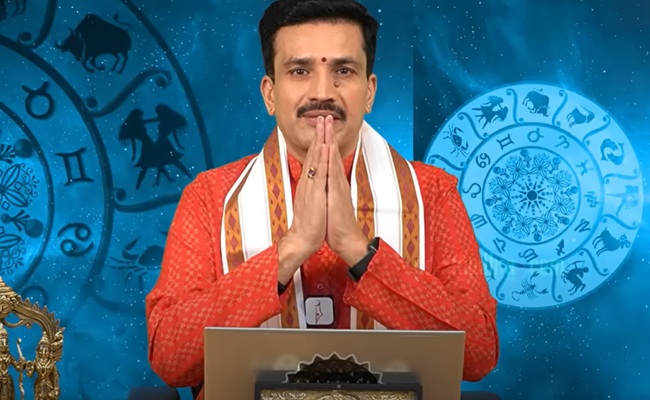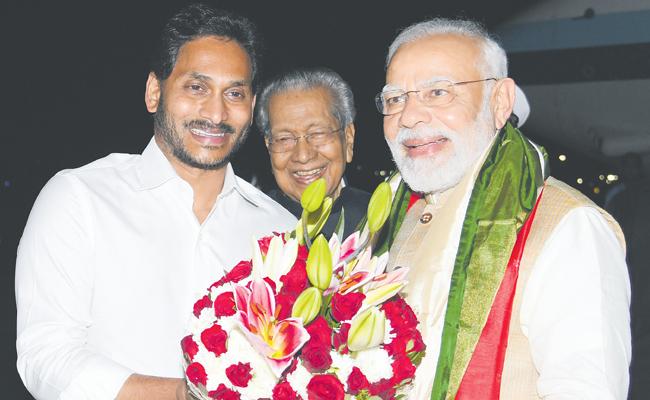
The not-so-strong response of the Bharatiya Janata Party to the latest controversy over political analyst Dr K Nageshwar’s comment that YSR Congress Party president Y S Jagan Mohan Reddy is a “permanent and committed friend” of the BJP has triggered a major debate in political circles in the state.
Though Andhra Pradesh BJP president P V N Madhav said all those facing corruption allegations, including Jagan, would have to go to jail sooner or later, he did not directly reject Nageshwar’s statement.
The BJP’s alliance partners in Andhra Pradesh — the Telugu Desam Party and the Jana Sena Party — reacted aggressively to Nageshwar’s remarks and even went to the extent of filing cases against him.
Yet the BJP leadership, both at the state and national levels, has largely avoided issuing a clear political clarification stating that Jana Sena chief Pawan Kalyan had never asked Union Home Minister Amit Shah to get Jagan arrested and that Shah had never said Jagan was the BJP’s committed friend.
The controversy intensified after Pawan Kalyan openly questioned the silence of BJP leaders during the party meeting in Mangalagiri.
He asked why Andhra Pradesh BJP leaders had failed to respond to the controversy, indirectly pointing to the BJP high command’s perceived soft corner towards Jagan Mohan Reddy.
In fact, senior Telangana BJP leader Muralidhar Rao even came to the rescue of Nageshwar and defended him, saying he might have made the statement based on his own information.
This led to speculation that at least some sections of the BJP do not view political engagement with the YSRCP as entirely unacceptable.
This has opened up a larger discussion in Andhra Pradesh political circles: Is the BJP quietly keeping the YSR Congress Party as a future political option ahead of the 2029 elections?
Sources say the BJP may not want to completely shut the door on future equations with the YSRCP.
Several political analysts believe there are strategic reasons why the BJP may prefer to maintain working channels with the YSRCP despite currently being part of the coalition government in Andhra Pradesh.
Unlike the TDP and Jana Sena, which are directly competing against the YSRCP at the grassroots level, the BJP’s political calculations operate at both state and national levels.
In Parliament, the BJP has historically benefited from issue-based support from regional parties, including the YSRCP, during crucial legislative moments.
Even after losing power in Andhra Pradesh in 2024, the YSRCP continues to retain a substantial vote base and political presence.
Analysts argue that the BJP may not want to completely antagonise a party that could still remain politically relevant in the future.
This is particularly important because the BJP’s long-term southern expansion strategy often depends on flexible regional alliances rather than rigid ideological alignments.
Political analysts say Pawan Kalyan now seeks clarity on whether the BJP sees the current Andhra Pradesh alliance as a long-term political arrangement or merely a strategic phase leading up to 2029.
According to analysts, politics is highly dynamic, and alliances often shift depending on electoral arithmetic, leadership equations and national priorities.
If political circumstances change dramatically by 2028 or 2029, especially if the BJP feels the need for an alternative regional partner in Andhra Pradesh, the YSRCP could once again emerge as a potential option.
This is precisely why the BJP’s current silence is attracting so much attention. By refusing to categorically rule out political proximity with Jagan Mohan Reddy, the party is allowing speculation to survive.