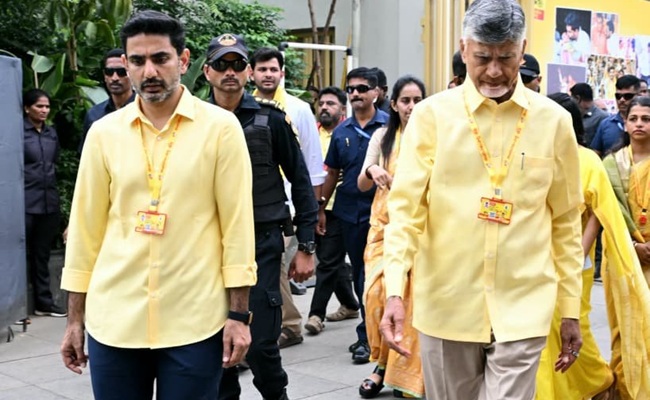
The just-concluded Mahanadu, the two-day annual conclave of the Telugu Desam Party, has triggered a discussion within party circles on whether the party is heading for a leadership transition from Chief Minister N Chandrababu Naidu to his son Nara Lokesh.
Naidu, who turned 76 a couple of months ago, is one of the oldest and most experienced serving chief ministers in India.
He will be 79 by the 2029 elections and will be entering his 80s.
Naturally, a stage has arrived in his five-decade-long political career where questions are being raised about when he should step down and hand over the baton to his son.
The question is no longer just about age, but about how and when such a political transition should be managed strategically.
According to analysts, Mahanadu offered clear indications about the party’s long-term direction.
The heavy projection of younger leadership, future-oriented presentations, aggressive social media campaigns and carefully designed public relations initiatives are being interpreted as signs that the TDP has quietly begun preparing the ground for a generational transition.
Like any other major political party in the country, the TDP, too, appears to have begun the exercise of first creating public acceptance for emerging leaders, then building psychological acceptance within the cadre, and eventually sending indirect signals to alliance partners regarding future power structures.
However, the role of Jana Sena Party president Pawan Kalyan remains crucial in projecting Lokesh as the future chief ministerial candidate of the TDP, as both parties are in alliance in Andhra Pradesh.
Though the BJP is also part of the alliance, it is unlikely to have any serious objection to Lokesh emerging as the heir apparent of the TDP.
While Pawan Kalyan personally shares a respectful relationship with Chandrababu Naidu, politically, the Jana Sena cadre are expected to seek a larger share in power in the coming years.
If leadership changes take place within the TDP, issues such as seat-sharing, cabinet representation and power distribution within the alliance could once again become subjects of intense negotiation.
As long as Chandrababu Naidu remains the undisputed face of the government, political adjustments within the alliance may remain manageable.
However, analysts believe that a post-Naidu power structure could significantly alter coalition equations, with Jana Sena potentially demanding a stronger stake in governance.
Even if leaders attempt to maintain balance, whether the party cadre would remain equally accommodating remains an open question.
However, there is talk within the TDP that the political succession should happen while the party is still in power, rather than after the next elections.
The argument is that any electoral setback would bring the situation back to square one, forcing Naidu to struggle for another five years to sustain the party.
Analysts say Naidu generally prefers phased transitions to sudden leadership changes.
He may adopt a hybrid model in which organisational control, administrative responsibilities and operational authority are gradually delegated to the next generation, while he continues as the alliance’s primary public face.
There is already speculation in political circles that some elements of this transition have quietly begun internally.
Discussions around new organisational structures, possible executive leadership roles and changes within the party hierarchy are being viewed as indicators of this evolving strategy.
The broader political objective appears to be maintaining Chandrababu Naidu as the stable NDA face while simultaneously strengthening future leadership without alarming the cadre or creating insecurity among alliance partners.
Lokesh is already maintaining a positive relationship with Pawan Kalyan, with repeated public gestures emphasising alliance unity and respect for the Jana Sena chief.
One option is to continue with Chandrababu Naidu as the unquestioned face of the alliance until 2029 while quietly preparing the next generation internally. This model offers maximum stability and preserves coalition chemistry.
A second option would involve projecting a new generation of leadership more aggressively by 2027 or 2028. While this could provide long-term succession advantages, it also carries significant political risk and uncertainty.
The third possibility is a hybrid model. Under this arrangement, Chandrababu Naidu would remain the principal political face, while the operational authority and political visibility of the next generation gradually increase over time.
Written By Usha Chowdhary