Praising a leader is perfectly normal in politics. However, excessive praise at the wrong time, without restraint in the choice of words, can easily backfire.
Prime Minister Narendra Modi has received widespread appreciation across the country since 2014 for his leadership and governance in various sectors. However, the current political atmosphere is different. With a section of the youth expressing anger and frustration over several issues, the timing of such emotional public praise appears less than ideal.
In such a climate, highly enthusiastic endorsements are more likely to attract criticism than appreciation.
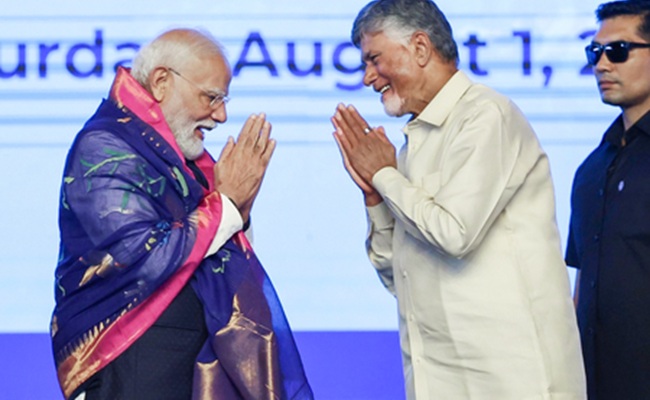
The inauguration of Bhogapuram International Airport near Visakhapatnam became more than just an infrastructure event. It also turned into a political talking point after Andhra Pradesh leaders showered Prime Minister Modi with unusually high praise, triggering intense debate on social media.
During the event, Andhra Pradesh IT Minister Nara Lokesh compared Modi with legendary freedom fighter Alluri Sitarama Raju.
“The determination, courage and patriotism that I see in Alluri Sitarama Raju are reflected in our Prime Minister Narendra Modi,” Lokesh said.
Chief Minister N Chandrababu Naidu remarked, “Without Modi, we cannot imagine 2047,” referring to the centenary of India’s Independence.
Deputy Chief Minister Pawan Kalyan’s emotional remarks drew even greater attention.
“If anybody hurts Modi, it hurts me. My eyes become wet,” he said.
The statement quickly went viral and became one of the most discussed moments from the event.
While it is not unusual for political leaders to praise the Prime Minister, many observers felt that the intensity of these remarks stood out.
The comments came at a time when the national political mood has been influenced by protests and criticism from sections of the youth, particularly over issues related to examinations, employment, governance and public spending.
Against this backdrop, many netizens questioned whether such excessive praise was politically prudent.
Adding to the debate, several social media users resurfaced old photographs and video clips from 2018 and 2019, when Telugu Desam Party leaders, including Chandrababu Naidu and Nara Lokesh, participated in “Go Back Modi” protests and wore black shirts while opposing the BJP-led Central government.
These old visuals were widely shared to highlight the dramatic shift in political equations.
Social media was soon flooded with reactions, many of them critical. Some users argued that Naidu’s praise was part of a political strategy and advised Modi to remain cautious while dealing with him.
Others said such excessive praise could irritate younger voters who are already unhappy with the BJP-led government at the Centre.
Some users also questioned the expenditure on welcoming the Prime Minister, arguing that public money could instead have been used to improve roads, create jobs or address other local issues.
A few posts pointed out that although the TDP and Jana Sena are strongly supporting the BJP, the saffron party still appears to be keeping its political options open with the YSR Congress Party.
Others compared the leaders’ remarks with Balakrishna’s political style, claiming that he had never indulged in such emotional praise and had always maintained his self-respect.
Pawan Kalyan faced particularly sharp criticism. Some users questioned why he had not shown similar emotion over the deaths of students or other public issues.
Others reminded him of his earlier criticism of Modi, including his remark that Andhra Pradesh had received only “two stale laddus” from the Centre.
One sarcastic Telugu post asked whether Pawan had shed tears when Chandrababu Naidu and Balakrishna criticised Modi in the past, adding that actors know exactly when to cry.
Several young social media users also argued that while respecting political allies is understandable, leaders should use more measured language instead of making highly emotional statements that may invite unnecessary public scrutiny.
Political alliances may change with time, but public statements remain on record. That is why restraint and timing are crucial, particularly when leaders speak at high-profile events.