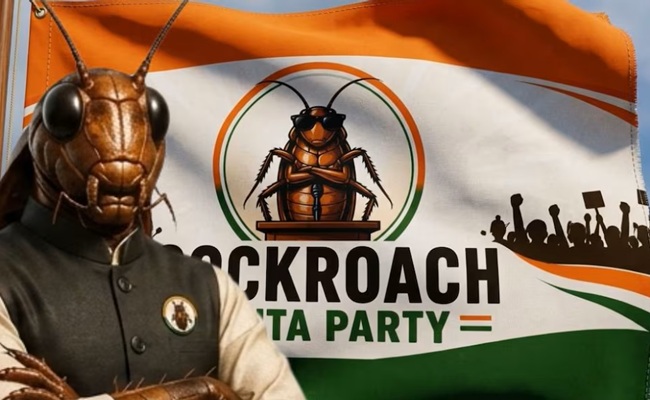
A satirical online movement called Cockroach Janta Party has suddenly become one of the biggest talking points in Indian politics and social media.
What began as a joke has now turned into a digital protest platform for lakhs of young Indians who feel ignored, unemployed, frustrated and angry with the system.
The movement was reportedly born after Chief Justice of India Surya Kant made a controversial remark referring to some unemployed youngsters as “cockroaches.” Though he later clarified that he was misquoted, the remark had already triggered strong reactions online.
Boston University student Abhijeet Dipke then launched the Cockroach Janta Party as a satirical response.
In just a few days, the CJP became a social media storm. Its Instagram account crossed millions of followers, even surpassing the follower count of major political parties such as the BJP and Congress on the platform. Reports said the party crossed 15 million followers within five days and later touched around 20 million.
The reason for its popularity is simple: it speaks the language of frustrated youth.
The CJP uses memes, satire, humour and sharp political messaging to talk about unemployment, inflation, paper leaks, exam failures, corruption, weak governance and lack of accountability. These are issues that directly affect students and young job seekers.
For many young Indians, the word “cockroach” became a symbol of insult. But instead of rejecting it, they turned it into a badge of protest. The movement’s message is that even if the system calls them useless, unemployed or lazy, they will still survive and question those in power.
The CJP’s appeal also lies in its style. It does not speak like a traditional political party. Its posters, captions and videos are designed for Instagram and X users. Its communication is direct, sarcastic and youth-friendly.
This is why many young people who usually stay away from politics are engaging with it. For them, the CJP is not just a parody party. It is an outlet for anger.
However, the movement has already faced pressure. Its X handle, which had reportedly crossed 2 lakh followers, was blocked following inputs citing “national security concerns.” After that, the founder started another handle called “Cockroach is Back.”
Congress MP Shashi Tharoor also reacted to the blocking of the account, saying democracies need outlets for dissent and satire. He called the move against such a platform unwise.
At the same time, questions are being raised about the future of the CJP. Is it only a viral trend? Can online anger turn into real political action? Can Instagram followers become voters, volunteers or ground-level campaigners?
Some political observers say social media popularity cannot be compared with actual political strength. India’s elections are fought through caste equations, local networks, booth-level workers, funding, alliances and ground mobilisation. A high follower count alone cannot defeat established parties.
There are also questions about political neutrality. While the CJP claims to be independent, reports have pointed out that its founder had earlier worked with the Aam Aadmi Party, leading to doubts over whether the movement is truly free from political bias.
Still, the CJP has clearly touched a nerve. Whether it becomes a political force or fades away as another internet trend, it has exposed one important reality: India’s youth is angry, restless and looking for a platform.
For now, the Cockroach Janta Party is operating mostly inside phone screens. Its rallies are memes, its slogans are posts, and its supporters are online followers.
But the message it has sent is loud enough: the youth may laugh, troll and make memes, but they are also watching, questioning and waiting for answers.