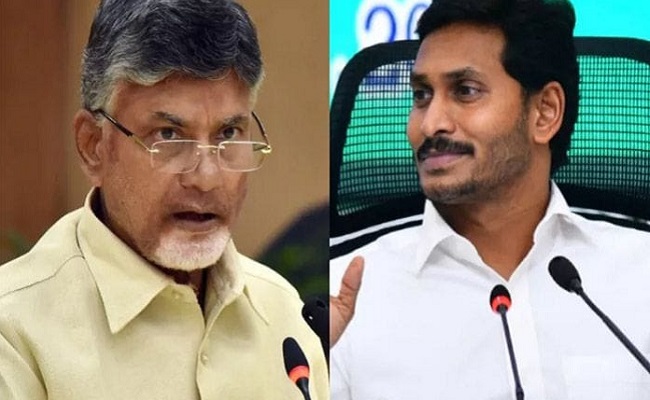
For the last 24 hours, the statement made by YSR Congress Party president and former Andhra Pradesh chief minister Y S Jagan Mohan Reddy has kept political analysts busy trying to understand why he has declared Mavigun as his agenda for the next Assembly elections.
Analysts have begun wondering why Jagan is attempting to revive the controversy now, at a time when construction work is progressing at a rapid pace in Amaravati, which has now received statutory status from the Centre.
Has Jagan scored a self-goal, or is there a clever strategy behind his decision to push the Mavigun versus Amaravati agenda for the next elections?
According to a senior journalist, Jagan’s strategy is purely political rather than a serious attempt to put forward a well-designed administrative proposal for the Mavigun capital.
According to him, if Amaravati reaches a stage where major government complexes are completed and private investment accelerates, the capital will gradually cease to be an election issue.
“It will become an accomplished fact. Governments, irrespective of party, will then be free to focus on employment, industry, education, healthcare and welfare instead of repeatedly defending or attacking the capital project,” he said.
That would also mean Chandrababu Naidu could claim credit for finally delivering what was promised a decade ago. For the opposition, that would change the political landscape.
Seen in that context, repeatedly raising “Mavigun” may be less about proposing an alternative capital model and more about signalling that Amaravati is not yet settled.
The message to investors could be that the project’s long-term future still depends on who wins the next election.
Whether that is the intended strategy is something only the YSRCP leadership can answer. But perceptions matter in investment decisions.
According to the journalist, investors rarely make decisions based solely on today’s government. They invest based on confidence that policies will remain stable for 10, 20 or 30 years.
“Universities, hospitals, IT companies, hotels and real estate developers all commit capital on the assumption that governments may change, but the rules of the game will not. But if political leaders repeatedly indicate that the capital city itself may change, uncertainty becomes part of the investment equation,” he said.
The cost of such uncertainty cannot always be measured in budget documents. A contractor may delay bidding for a project; a university may postpone a campus; a multinational company may choose another state; or a hotel chain may defer expansion.
“Banks may become more cautious in financing projects. None of these decisions immediately appears in official statistics. Yet collectively, they influence the pace of development,” he said.
The financial implications are equally significant. The state has already committed tens of thousands of crores to roads, trunk infrastructure, government buildings and civic amenities in Amaravati.
Central assistance, institutional funding and private participation have also been mobilised. If political uncertainty once again interrupts the project, Andhra Pradesh risks paying twice — once for incomplete infrastructure and again for restarting or redesigning projects in the future, the journalist said.
There is also the issue of credibility. Over the past two years, the state has worked hard to rebuild investor confidence after a period when several projects were either reviewed or delayed.
“Global investors, including companies in data centres, electronics, manufacturing and renewable energy, have begun announcing fresh investments. Investment is built on predictability. The perception that even the location of the capital remains politically negotiable could weaken that confidence, irrespective of which party is in power,” the journalist pointed out.
Finally, there is the question of political stability. Capital cities are meant to provide administrative continuity. If every election becomes a referendum on the capital itself, governance risks becoming cyclical.
“Long-gestation projects, which typically require 10 to 15 years, cannot be planned effectively if they are vulnerable to reversal every five years. That is why Jagan’s decision to elevate ‘Mavigun versus Amaravati’ into a central political issue is such a high-stakes gamble,” he said.
If voters endorse that approach, Andhra Pradesh could once again enter a prolonged debate over its capital. If they reject it, Amaravati may finally move beyond politics and become simply the state’s administrative capital.
The next election, therefore, may not just determine who governs Andhra Pradesh. It may determine whether the state finally closes the capital chapter or reopens it yet again.