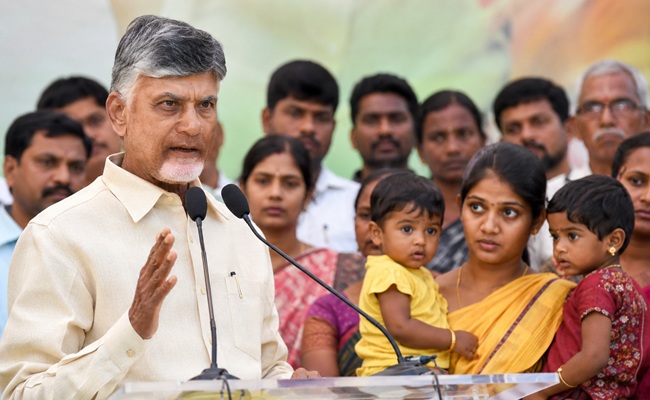
Andhra Pradesh Chief Minister N Chandrababu Naidu has unveiled a new policy aimed at encouraging population growth by offering financial incentives to families having more children.
As part of the proposal, families would receive Rs 30,000 for the birth of a third child and Rs 40,000 for a fourth child, as the government seeks to address the state’s falling fertility rate.
With Andhra Pradesh’s total fertility rate said to have declined to nearly 1.5, Chandrababu Naidu believes the state must encourage bigger families to avoid future demographic challenges and an ageing population situation similar to those faced by countries such as Japan and South Korea.
However, many people are questioning the comparison itself. Andhra Pradesh is a state within India and cannot be directly compared to countries such as Japan and South Korea.
India still has a massive youth population, especially in states like Bihar, Odisha, West Bengal and Assam. Many young workers from these regions migrate to the Telugu states for jobs as construction workers, restaurant staff, delivery workers and labourers in several sectors.
Because of this internal migration, population and workforce needs within the country naturally adjust from one region to another.
Critics argue that a falling fertility rate in Andhra Pradesh alone does not necessarily create a national crisis.
Many observers are also raising concerns about the financial practicality of the scheme.
If a poor or below-poverty-line family decides to have a third child after hearing about the government incentive, the expenses begin long before the child is born.
From conception to delivery, proper nutrition, medical care and support for a healthy pregnancy can itself cost Rs 20,000 or more over nine months.
Even if the delivery takes place in a government hospital, additional expenses for medicines, baby care, feeding and other essentials can easily add at least another Rs 20,000 within a short period.
In that context, critics argue that even a Rs 30,000 incentive does not meaningfully cover the bill.
Raising a child requires continuous support for at least two decades, while government assistance usually ends after the incentive amount is paid.
Some fear that financially stressed families may struggle to provide quality education and care, increasing the chances of children falling into unhealthy or unsafe environments later in life.
A doctor working at a government hospital expressed concern over the proposal.
“Having more children in poor families has become a burden these days. With rising prices and changing lifestyles, many teenagers are falling into drugs, alcoholism and even crime. I admire the TDP, but Chandrababu Naidu’s scheme appears misleading and harmful in the long run,” the doctor said.
Social media reactions have also been largely critical.
One user wrote, “The idea itself is mindless. Chandrababu wants a larger Telugu population for the political benefit of future generations. Encouraging people to have more children for money is irresponsible.”
Another comment suggested that the move was politically motivated.
“It is becoming difficult to find blue-collar workers among Telugu people because many educated youth are moving abroad. This policy seems aimed at creating a larger dependent population that future political leaders can rely on as voters,” the user said.
Another social media user mocked the argument that increasing the population would help Andhra Pradesh gain more parliamentary representation.
“Expecting people to suffer the financial burden of raising more children for 20 years just to gain more MP seats sounds ridiculous,” the user wrote.
According to political observers, even some leaders within the Telugu Desam Party are privately expressing doubts and laughing at the proposal during informal discussions.
Overall, Chandrababu Naidu’s “Mission More Population” campaign is receiving widespread trolling and criticism across social media and political circles, making it one of the most debated proposals in recent times.