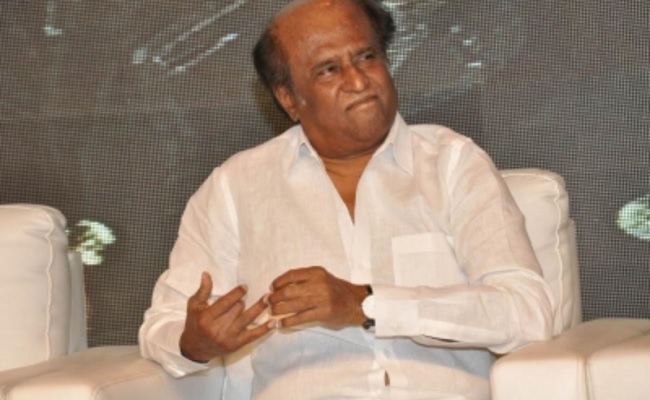
Rajinikanth has always projected himself as someone different from the rest of India’s top stars.
He gained immense popularity and remained the country’s biggest pan-Indian superstar for decades, while continuing to enjoy unmatched respect and brand value.
Even a song like Lungi Dance, dedicated to him by Shah Rukh Khan in Chennai Express, reflected the unique image Rajinikanth had cultivated over the years.
Beyond style and success, Rajinikanth always appeared transparent, simple and humble in public life.
He often appeared without makeup, avoided wigs outside films unlike many other stars, and became known for his spiritual talks and simple pilgrimages.
Many believed that after decades of stardom, he had mentally moved towards a phase of detachment and renunciation.
However, the developments of the past few weeks seem to have changed that perception.
Critics now argue that Rajinikanth has damaged his image by displaying signs of immaturity, jealousy and political insecurity.
After the Tamil Nadu election results, instead of first congratulating Vijay, he reportedly met M K Stalin of the defeated DMK camp.
There is also political speculation that he tried to indirectly influence forces opposing Vijay’s rise as Chief Minister.
Whether it was done out of personal interest or due to the influence of his close connections in BJP circles in Delhi, many feel these developments exposed Rajinikanth in a political role that sharply contradicted the image he had carefully built for decades.
Rajinikanth’s comments on Vijay becoming Chief Minister also sparked criticism, with many feeling that he sounded arrogant by stressing the age difference between them.
Though Rajinikanth is a cinema legend, Vijay proved himself politically by entering the battlefield, facing major rivals and winning power.
Rajinikanth’s statement that he would have won if he had entered politics was widely mocked because he spent decades hinting at political entry but ultimately backed away.
His comparison with Kamal Haasan was also seen as misplaced, since Kamal failed to make a major political impact.
Overall, Vijay is being projected as bold and successful, while Rajinikanth is being criticised for avoiding political risks despite making promises to fans for years.
Rajinikanth’s political indecisiveness has a history spanning nearly three decades.
In 1996, when public anger against J Jayalalithaa was high, Rajinikanth strongly opposed the Congress alliance with her and famously declared that even God could not save Tamil Nadu if she returned to power. His support helped the DMK-TMC alliance achieve a sweeping victory.
Critics argue that despite enjoying massive public support at that time, Rajinikanth never had the courage to launch his own party.
Now, after Vijay succeeded politically through direct struggle, Rajinikanth’s remarks are being viewed as frustration from someone who remained only a spectator in politics.
Whatever the real reasons may be, Rajinikanth appears to have damaged his carefully built image by getting involved in this murky political situation.
Many feel his recent actions exposed insecurity, political opportunism and personal bias, which sharply contrast with the humble and detached persona he maintained for decades.
One also wonders what exactly Rajinikanth expects from the Government of India at this stage of his life and career.
The only major honour left for him is the Bharat Ratna. He has already received the Padma Vibhushan, India’s second-highest civilian honour, and the prestigious Dadasaheb Phalke Award, the highest recognition in Indian cinema.
There is now speculation over whether his perceived proximity to the BJP establishment is driven by hopes of receiving the Bharat Ratna in the coming years. Only time will tell.
Usha Chowdhary