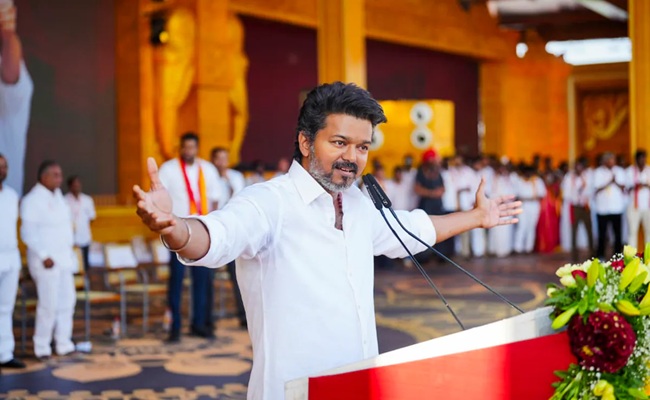
C. Joseph Vijay, now the Chief Minister of Tamil Nadu, was projected as a fresh alternative, a “people’s leader” who would rise above the stale formulas of Dravidian politics.
His speeches carried the tone of reform, his campaign carried the fragrance of revolution, and his fans carried cut-outs taller than apartment buildings. Naturally, expectations were sky high.
But now comes the unavoidable question; is Vijay truly different from the political class he criticized? Or is he simply another actor who mastered the transition from cinema dialogue to political dialogue? Because, so far, the signs are familiar.
Modern elections increasingly seem to run on only two fuels; anti-incumbency and appeasement politics. Ideology has become decorative wallpaper; manifestos are now closer to festival pamphlets promising “Buy One Get Five Free.”
Vijay’s campaign promises were no exception. He promised 8 grams of gold for newlywed brides, Rs 2500 per month for every family, and several other welfare schemes designed to strike emotional chords. That was a routine thing that every politician does.
But almost immediately after taking oath as Chief Minister, Vijay stated that the previous government had left behind debts of nearly Rs 10 lakh crore, and therefore his government needed time before implementing these schemes.
Now, here comes the awkward part.
The DMK government itself had already publicly released detailed financial reports months earlier outlining the state’s debt situation. This was not some hidden treasure map discovered only after swearing in as Chief Minister. The numbers were already in the public domain before Vijay released his manifesto.
Which naturally raises the question; if the financial condition of the state was already known, were those promises realistic plans or merely election-season poetry?
And that becomes the first crack in the “different politician” image. Then comes ideology.
- Vijay declared that he would not align with religion-centric parties like the BJP. Fair enough, that was his political stance. But then he aligned with the IUML, the Indian Union Muslim League, a party explicitly rooted in religious identity politics. Suddenly, the principle seemed less like a principle and more like a selectively activated mobile data pack.
- Similarly, Vijay stated that caste politics had no place in his approach and that he opposed caste-centric political structures. Yet he aligned with the VCK, a party whose political identity is deeply tied to caste mobilization.
To elaborate, the VCK draws much of its strength from the Paraiyar community, a major Dalit sub-group, and has historically positioned itself around caste-based rights and representation.
In northern Tamil Nadu, the party has long had friction with the PMK, which largely represents the Vanniyar community. In practical political terms, VCK heavily rooted in caste equations, the very thing Vijay claimed he wanted to move beyond.
- And then comes perhaps the most ironic chapter. Vijay criticized dynastic and nepotistic politics, something many Indians are genuinely frustrated with. Yet he associated himself with Rahul Gandhi’s Congress party, arguably one of the biggest symbols of political dynasty in India.
At this point, one begins to wonder whether ideology in Indian politics has become like the “Terms and Conditions” section of an app, technically present, but rarely followed.
What is increasingly getting exposed is this; when it comes to capturing power, even leaders marketed as “revolutionary” often end up adapting to the same old political mathematics they once criticized.
Perhaps Vijay is not an exception to the system. Perhaps the system itself slowly absorbs everyone.
Cinema allows heroes to defeat corruption with a single monologue. Politics, unfortunately, demands alliances, compromises, contradictions, and selective silence.
And somewhere between campaign speeches and coalition meetings, the revolutionary image begins to fade, replaced by something much more ordinary; just another politician trying to survive the game.
What lies ahead for Vijay will ultimately depend on how he withstands the opposition’s questions, how sincerely he fulfills his election manifesto, and how effectively he navigates the rough waters of politics while retaining people’s confidence.
Campaign speeches can create excitement, but governance is where political credibility is truly tested. If Vijay manages to deliver on his promises, maintain administrative stability, and survive the inevitable political pressures without completely abandoning his principles, he could still emerge as a respected and capable leader despite the visible ideological contradictions surrounding him today.
Usha Chowdhary
(The author is a senior journalist)
Disclaimer: These are the personal opinions of the author