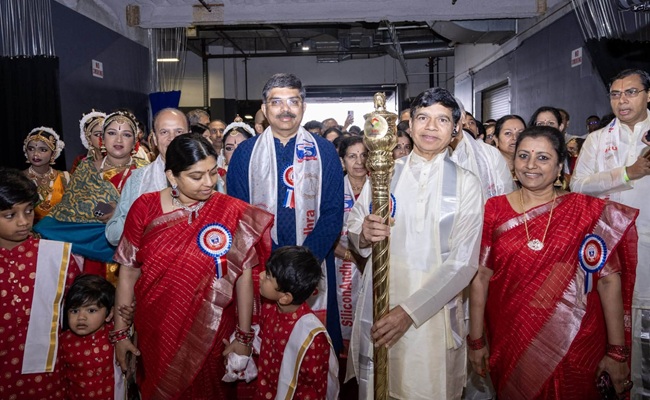
I attended Silicon Andhra's Silver Jubilee celebrations, and one thought stayed with me throughout the event. It was a slap on the face of almost every major Telugu association in the United States.
For decades, TANA, NATS, ATA and the now-defunct NATA have organized grand conventions. Most have become expensive showcases packed with celebrities, VIP culture, Banquet parties and entertainment while meaningful community building remains an afterthought.
After spending millions over the years, what permanent legacy have these organizations created? Grand stages disappear in days, but institutions live forever. Sadly, very little lasting infrastructure has emerged despite decades of existence.
Even ambitious promises such as building a dedicated TANA building never became reality. That says everything about the difference between grand speeches and actual execution.
What have these associations really done to preserve Telugu among children born and raised in America? Beyond occasional cultural shows, serious language preservation has rarely been their priority.
Silicon Andhra, led by Kuchibhotla Anand, chose a completely different path. It built institutions instead of publicity. It established Aria University, formerly known as the University of Silicon Andhra, in Milpitas. It pioneered ManaBadi in person classes are held on weekends in 250+ locations across US and Canada. SiliconAndhra mostly rents class rooms from local schools.
As if that was not enough, Silicon Andhra is now working towards establishing a medical college in California. That is an extraordinarily rare achievement for a Telugu organization abroad. No other Telugu association, despite decades of existence and enormous resources, has even attempted something on this scale.
The Silver Jubilee event showcased what vision can achieve. Around 10,000 to 15,000 people attended the ten-hour celebration, which also created three Guinness World Records for Telugu traditions, padyalu and Carnatic music.
Every moment reflected the fragrance of Telugu language and culture. Kuchipudi, classical music and Vande Bharatam celebrated heritage instead of glamour.
The event's financial model was equally refreshing. Entry was just $25. Food was sold through affordable vendor stalls instead of catering. Families enjoyed freedom of choice, vendors reportedly benefited from huge crowds and organizers avoided unnecessary extravagance.
There were no film stars flown in from India, no politicians seeking publicity, no heroines for token appearances and no costly celebrity concerts. Thousands of local Telugu participants became the real stars of the event.
Contrast this with the recurring criticism surrounding several other Telugu conventions. Political camps, caste equations, VIP treatment, expensive hospitality to Indian celebrities at the cost of associaton funds, food management controversies and other distractions often dominate discussions instead of community service.
Some organizations proudly highlight fundraising to send the bodies of deceased Telugu students and workers back to India. That humanitarian service deserves appreciation. But is that alone enough for organizations of this size and financial strength? Should their biggest achievement stop there? What the hell have they been doing all these decades besides organizing conventions?
These conventions are almost always held in expensive star hotels and convention centers, adding enormous costs every single time. Why did none of these associations ever think of building their own convention facility that could significantly reduce expenses for future events? Why should only SiliconAndhra demonstrate what long-term vision and institution building look like?
Silicon Andhra proved that vision defeats vanity. It builds universities, teaches Telugu, is working towards a medical college and empowers ordinary families instead of celebrities. American Telugu associations should stop chasing glamour and start building a legacy.
Silicon Andhra's Silver Jubilee was not just a celebration. It was a wake-up call and a shameful mirror held before every other Telugu association.