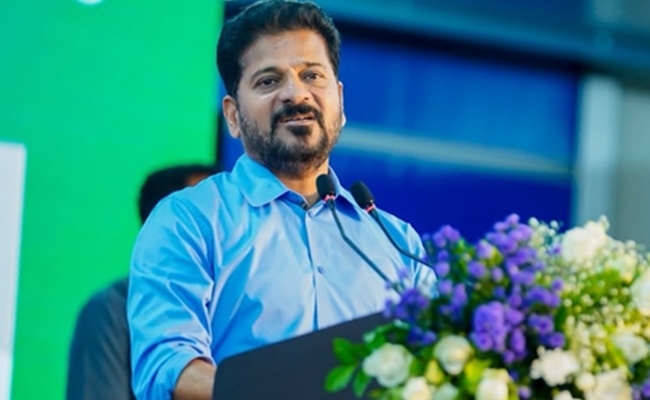
Telangana Chief Minister A Revanth Reddy’s proposal to lower the minimum age required to contest legislative elections has triggered widespread discussion. Supporters describe it as a significant step towards increasing youth participation in politics, while critics are expected to question its practical implications.
Speaking during a candlelight rally on Saturday night, the Chief Minister proposed greater representation for members of Generation Z in legislative institutions. He explained the idea in detail during an interaction with the national media on Sunday.
He said the Telangana Assembly would pass a resolution and forward it to the Union government, seeking the necessary constitutional amendments.
Revanth Reddy argued that if several developed countries have seen leaders assume high public office in their early twenties, Indian youth should also be given similar opportunities to participate directly in democratic governance.
Under his proposal, the minimum age for contesting elections to the Lok Sabha and State Legislative Assemblies would be reduced from 25 to 21 years. The eligibility age for the Rajya Sabha and State Legislative Councils would be lowered from 30 to 25 years.
The Chief Minister said India’s youth should move beyond street protests and become active participants in the legislative process, where they could directly influence policymaking and governance.
He argued that increasing the number of younger legislators would create a healthy balance between experience and fresh perspectives, while also encouraging a greater sense of responsibility among the younger generation.
Revanth Reddy recalled earlier constitutional reforms introduced by Congress governments. He noted that the 61st Constitutional Amendment, passed during former Prime Minister Rajiv Gandhi’s tenure, reduced the voting age from 21 to 18 years.
He also pointed out that during former Prime Minister P. V. Narasimha Rao’s tenure, the minimum age for contesting elections to urban and rural local bodies, including posts such as mayors and Zilla Parishad chairpersons, was reduced from 25 to 21 years.
Citing examples, he said a woman was able to become the Mayor of Thiruvananthapuram at the age of 21 because of these reforms.
He further observed that although Generation Z accounts for nearly 30 per cent of India’s population, its representation in the 543-member Lok Sabha remains below one per cent.
The Chief Minister also questioned why young Indians are eligible to join the country’s elite civil services at the age of 21 but cannot contest elections to Parliament or State Assemblies at the same age.
He referred to senior civil servants who entered the Indian Administrative Service or Indian Police Service in their early twenties to support his argument.
Revanth Reddy said ministries closely connected with younger generations, such as education and information technology, would benefit from greater participation by young legislators who better understand their aspirations and challenges.
The proposal has sparked debate over how to balance youthful representation with legislative experience.
Supporters argue that lowering the age limit would modernise India’s democratic institutions and encourage greater youth participation. Critics, however, are likely to raise concerns about political maturity and governance experience.
At present, the minimum age for contesting elections to the Lok Sabha and State Legislative Assemblies is 25 years. It is 30 years for the Rajya Sabha and State Legislative Councils, and 35 years for the offices of President, Vice President and Governor. Candidates can contest local body elections from the age of 21.