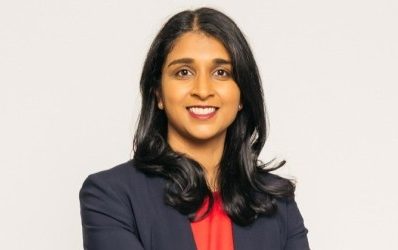
Indian American lawyer and former federal prosecutor Saritha Komatireddy is emerging as one of the Republican Party’s most closely watched candidates this election cycle.
She is campaigning to unseat incumbent New York Attorney General Letitia James in the 2026 race for the state’s top legal office.
Komatireddy, a former Assistant U.S. Attorney and national security prosecutor, officially secured the backing of New York Republicans earlier this year after projecting herself as a law-and-order candidate focused on crime, public safety, terrorism prosecutions and government accountability.
The New York Attorney General election is scheduled for November 3, 2026.
The contest is expected to become one of the most high-profile state legal battles in the country, given James’ long-running legal conflicts with President Donald Trump and his business empire.
Komatireddy was born to Indian immigrant parents from Telangana who settled in the United States in the 1980s, according to campaign and media reports.
She grew up in Missouri before building a legal career centred on counterterrorism and organised crime prosecutions.
She has repeatedly said the September 11 attacks shaped her decision to pursue law and national security work.
After law school, Komatireddy joined the U.S. Attorney’s Office for the Eastern District of New York, where she spent more than a decade prosecuting terrorism, narcotics trafficking, cybercrime, money laundering, fraud and foreign corruption cases.
Reports say she worked on investigations involving Al Qaeda, ISIS operatives and international criminal networks.
She later served in senior roles connected to the Drug Enforcement Administration and also clerked for Supreme Court Justice Brett Kavanaugh earlier in her legal career, according to interviews and campaign material.
Komatireddy has framed her campaign around public safety concerns and criticism of what she describes as the politicisation of the Attorney General’s office under James.
“I’m running for Attorney General because we need a prosecutor in charge, focused on New York and focused on safety,” she said while launching her campaign.
During the New York Republican convention, she accused James of prioritising partisan legal fights over ordinary public safety issues.
“From now until November, I will prosecute the political case against Letitia James, and unlike her, I win my cases,” Komatireddy told party delegates.
She has also argued that New Yorkers are increasingly frustrated by violent crime, subway safety concerns, drug trafficking and what Republicans describe as soft-on-crime policies.
James remains one of the Democratic Party’s most nationally recognised state officials because of her legal battles involving Trump, the Trump Organization and former New York Governor Andrew Cuomo.
Republicans hope Komatireddy’s prosecutorial background and immigrant family story could help broaden the party’s appeal among suburban voters, Asian Americans, Indian Americans and professional immigrant communities in New York.
Political analysts, however, say Republicans still face a difficult path in statewide New York elections, where Democrats maintain a significant voter registration advantage.
The race has also attracted attention among South Asian American political observers, as Komatireddy joins a growing list of Indian American candidates seeking major statewide offices across the United States.
Online reactions to Komatireddy’s candidacy reflect the broader national divide surrounding James and Trump-era legal battles.
Conservative commentators and Republican activists have praised her background as a terrorism prosecutor and outsider candidate.
Some supporters argue that New York voters are seeking a tougher approach to crime and public corruption.
Critics, meanwhile, question whether a Republican candidate can realistically win statewide office in New York, given the state’s strong Democratic lean.
Still, Komatireddy’s candidacy has already elevated her national profile, especially among Indian American conservatives and diaspora communities closely following the growing political influence of South Asian Americans in U.S. elections.